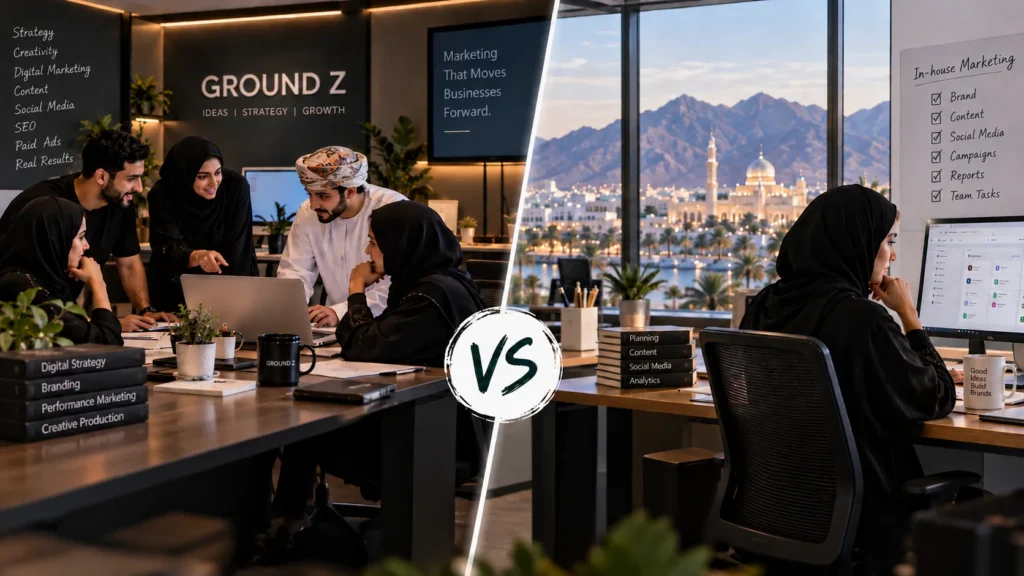
Choosing between a digital marketing agency vs in house team is not simply a question of hiring an agency or employing marketers. It is a decision about how your business plans, creates, manages, measures, and improves its digital activity. A digital marketing agency gives you access to a wider group of specialists, while an in-house team gives you people who work inside your company every day and know its internal processes closely. The better option depends on your goals, budget, business size, industry, workload, and how much marketing expertise you need.
For businesses in Oman, the decision can be even more specific. A company in Muscat may have different needs from a business serving customers in Salalah, Sohar, Nizwa, or several Omani cities at the same time.
A B2B technology company may need a different setup from a restaurant, real estate company, retail brand, or professional service provider. That is why comparing digital marketing agency vs in house should start with the actual work your business needs, not with the label attached to the marketing team.
Digital Marketing Agency vs In House: What Is the Real Difference?
The simplest difference is this: an in-house marketing team works directly inside your company, while a digital marketing agency works as an external partner that provides marketing expertise and execution.
An in-house team normally consists of employees hired by the company. Depending on the business, this could mean one marketing executive or a larger department with specialists in content, social media, paid advertising, design, SEO, email marketing, analytics, and strategy.
An agency operates differently. Instead of hiring every specialist separately, the business works with a team that already has different roles and skills.
In the digital marketing agency vs in house comparison, this creates an important difference in structure.
| Area | Digital Marketing Agency | In-House Team |
| Team structure | External specialists | Company employees |
| Access to skills | Usually broader | Depends on hiring |
| Company knowledge | Builds over time | Usually very strong |
| Hiring responsibility | Mostly handled by agency | Handled by company |
| Scaling | Usually easier | Requires hiring or restructuring |
| Tools | Agency may already have professional tools | Company pays for tools |
| Daily communication | External meetings and reporting | Direct internal communication |
| Industry exposure | Often works with several industries | Focuses mainly on one company |
| Management | Shared with agency | Fully controlled internally |
| Specialist coverage | Can include several specialists | May require multiple hires |
Neither model is automatically better.
The right question is not, “Which one is more professional?”
The better question is, “Which structure can consistently handle the work my business actually needs?”
That change in thinking makes the digital marketing agency vs in house decision much easier.
Digital Marketing Agency vs In House: What Does an In-House Team Actually Do?
An in-house team is built around the company itself. The marketers are part of the organization, attend internal meetings, understand company priorities, and usually have direct access to sales, customer service, product, management, and other departments.
In the digital marketing agency vs in house discussion, this internal access is one of the strongest advantages of an in-house team.
For example, imagine an Omani technology company launching a new software service.
The internal marketing employee may sit in the same office as the sales manager and product team. When the product changes, marketing can hear about it immediately. When sales notices that customers are asking a particular question, the marketer can quickly change the content.
That proximity can be extremely useful.
An in-house team may handle:
- Social media management
- Content creation
- Email campaigns
- Paid advertising
- Website updates
- Lead generation
- Campaign planning
- Marketing reports
- Customer research
- Brand communication
- Coordination with sales
- Promotional activities
However, there is an important limitation.
One person cannot realistically be an expert at everything.
A marketing executive may be good at social media but weak in paid search. Another employee may understand content but have limited experience with analytics. A designer may create strong visuals but not know how to build a complete acquisition strategy.
This is where the digital marketing agency vs in house comparison becomes more complicated than simply comparing employee salaries with agency fees.
Digital Marketing Agency vs In House: What Does a Digital Marketing Agency Provide?
A digital marketing agency usually works as a group rather than as one generalist employee.
The exact structure varies, but an agency may include strategists, account managers, content writers, designers, paid advertising specialists, SEO professionals, social media specialists, developers, video producers, and analysts.
This means a company can access several skill sets without employing every specialist permanently.
For example, a company may need:
- A paid advertising specialist for Google Ads.
- A social media specialist for daily content.
- A designer for campaign visuals.
- A copywriter for landing pages.
- An analyst for campaign reporting.
- A strategist to connect all these activities.
Hiring all six people internally is possible, but it is a much larger organizational commitment.
An agency can provide access to these roles through one external relationship.
That is one of the main reasons businesses compare a digital marketing agency with an in-house department.
Digital Marketing Agency vs In House: Which One Gives You More Expertise?
If the question is purely about the number of specialist skills available, an established digital marketing agency will often have an advantage.
But expertise is not only about the number of people.
An in-house marketer can develop deep knowledge of the company’s products, customers, sales process, pricing, internal politics, and long-term objectives. That knowledge can be difficult for an external team to reproduce quickly.
An agency, however, can bring experience from different projects and industries. This can help when the company faces a marketing problem that its internal employees have never handled before.
For example, an in-house marketer may understand a company’s social media audience very well but have never managed a major B2B lead-generation campaign.
An agency may have handled similar campaigns before.
So in the digital marketing agency vs in house comparison, the real question is not simply “Who knows my company better?”
It is also: “Who has the right experience for the problem I am trying to solve?”
Digital Marketing Agency vs In House: The Difference Between Generalists and Specialists
This is one of the most important parts of the digital marketing agency vs in house decision.
Small companies often begin with generalists.
One employee might manage Instagram, write captions, coordinate advertisements, update the website, prepare reports, and speak with management.
That can work for a while.
The problem starts when the marketing operation becomes more complicated.
Suppose the company now needs SEO, paid advertising, short-form video, conversion tracking, landing pages, email automation, and B2B lead generation.
- The workload has changed.
- The employee has not suddenly become six different specialists.
This is where a digital marketing agency can provide a different operating model.
Instead of expecting one person to master every discipline, the company can work with specialists according to the needs of the campaign. This does not mean agencies always win.
A large company with enough budget and a mature marketing department may build an excellent internal team. The important issue is whether the company has enough work, budget, management capacity, and strategic need to justify that structure.
Digital Marketing Agency vs In House: Cost Is More Than a Monthly Salary
Cost is one of the first things companies ask about when comparing digital marketing agency vs in house.
A common mistake is to compare an agency’s monthly fee with the salary of one marketing employee.
That is not an equal comparison.
If a company hires one marketer, the actual cost may include:
- Salary
- Recruitment
- Training
- Employee benefits
- Software
- Advertising platforms
- Design tools
- Analytics tools
- Content production
- Equipment
- Management time
- Additional specialists
- Vacation and absence coverage
The same applies to an agency.
An agency fee may include several services that would otherwise require multiple employees or external suppliers.
For example, a company paying an agency for social media management, paid advertising, creative design, reporting, and strategy is not necessarily comparing the agency fee with the salary of one employee. It is comparing one external marketing system with the cost of building several internal capabilities.
This is why the financial side of the digital marketing agency vs in house decision should be calculated over the full operating model.
Digital Marketing Agency vs In House: When Is In-House Marketing More Cost Effective?
An in-house team can become financially attractive when a company has a large and stable amount of marketing work.
Imagine a company that needs marketing activities every day, has multiple products, runs several campaigns every month, and already has enough management resources to supervise specialists. Hiring internally may make sense.
The company can build a dedicated department and gradually develop its own processes.
In the digital marketing agency vs in house comparison, internal hiring can also make sense when marketing knowledge is a major part of the company’s competitive advantage.
For example, a company with highly specialized technical products may want marketers who spend years learning its industry. That knowledge can become valuable. But an in-house structure becomes less efficient when the company hires people without enough work to keep their specialties active.
A business may hire a full-time designer even though it only needs advanced campaign design a few days each month.
It may hire an SEO Agency even though the website requires only limited technical work. The company is then paying for capacity that it does not always use.
Digital Marketing Agency vs In House: When Does an Agency Make More Sense?
A digital marketing agency can be a strong option when the company needs several skills but does not want to build a complete internal department.
This is especially relevant for:
- Small businesses
- Growing companies
- New brands
- Companies entering new markets
- Businesses with limited internal marketing expertise
- Companies launching new products
- Businesses needing specialist campaigns
- Companies that need temporary additional capacity
The agency model can also help when the business needs to move quickly.
Instead of recruiting several employees, interviewing candidates, negotiating salaries, onboarding staff, and purchasing tools, the company can start with an existing team. That does not mean an agency removes all management work.
The company still needs to provide information, approve important decisions, share business goals, and give useful feedback.
Good marketing is rarely completely hands-off.
Digital Marketing Agency vs In House: What About Control?
Control is another major point in the digital marketing agency vs in house debate.
With an in-house team, management has direct control over employees, schedules, priorities, processes, and internal communication. The team can sit with sales in the morning, speak with management in the afternoon, and adjust a campaign quickly.
With an agency, control works differently.
The business controls the objectives, brand direction, budget, approvals, and strategic priorities. The agency controls how its team organizes the work within the agreed scope. Some business owners prefer this arrangement because they do not want to manage every marketing task.
Others prefer internal employees because they want marketing decisions to remain completely inside the company.
Neither preference is wrong.
The issue is management style.
Digital Marketing Agency vs In House: Which Team Understands the Customer Better?
This question has no universal answer.
An in-house team has continuous exposure to the company’s customers. They may speak with sales teams, read customer complaints, attend product meetings, and see how customers respond to offers.
That gives the internal team valuable context.
But an experienced digital marketing agency can bring another type of understanding.
Agency teams often see patterns across different accounts. They may notice that a landing page has too many steps, an advertisement is attracting the wrong audience, or a social media campaign is creating engagement without meaningful business actions.
In the digital marketing agency vs in house comparison, one team may have deeper company knowledge while the other may bring broader external perspective.
The strongest setup often combines both.
Digital Marketing Agency vs In House: Strategy and Execution Are Not the Same
A business may have enough people to execute marketing but still lack a clear strategy.
This is a common problem in the digital marketing agency vs in house discussion. Having someone post every day does not automatically mean the company has a marketing strategy.
A strategy should answer questions such as:
- Who are we trying to reach?
- What problem do we solve?
- Which channels matter?
- What is the main business objective?
- What action should customers take?
- Which markets are priorities?
- How will leads be measured?
- What happens after a lead arrives?
- Which campaigns should receive more budget?
- What should be changed when performance is weak?
A digital marketing agency may bring strategic planning experience, but the company still needs to provide business information. An in-house team may know the business extremely well, but it may need external expertise for strategy.
The key is separating knowledge of the company from knowledge of marketing systems.
Digital Marketing Agency vs In House: Digital Marketing Is Bigger Than Social Media
A common mistake is to treat digital marketing as social media posting.
The digital marketing agency vs in house decision should consider the full digital ecosystem.
Digital marketing can include:
- Search engine optimization
- Paid search
- Social media
- Content marketing
- Email marketing
- Landing pages
- Online advertising
- Conversion optimization
- Analytics
- Influencer campaigns
- Video marketing
- Marketing automation
- Local digital campaigns
- Lead generation
This distinction is important when comparing digital marketing agency services with an internal social media employee.
A person managing Instagram may be doing useful work, but that does not necessarily mean the company has a complete digital marketing operation. Businesses should understand the difference between channel management and marketing strategy.
For readers comparing channels, the relationship between digital marketing vs social media marketing is also worth understanding because social media is only one part of the wider digital marketing process.
Digital Marketing Agency vs In House: What Happens When You Need Social Media Specialists?
Social media is often the first place where companies build an internal marketing role.
The employee creates posts, answers comments, prepares stories, coordinates campaigns, and communicates with customers.
That can be effective.
But a serious social media operation can involve much more.
The company may need:
- Content planning
- Creative direction
- Photography
- Video production
- Copywriting
- Community management
- Paid social advertising
- Audience research
- Performance analysis
- Influencer coordination
At this stage, the digital marketing agency vs in house comparison becomes a question of capacity.
Can the internal team handle all of these functions at the required quality and frequency? If not, the business can either hire more employees, outsource selected tasks, or work with an agency.
A business looking specifically for specialist support may also compare an agency model with a dedicated social media marketing agency
Digital Marketing Agency vs In House: What Changes for B2B Companies?
B2B marketing is another area where the choice between digital marketing agency vs in house needs careful consideration.
B2B marketing often involves longer buying cycles.
A customer may not see one advertisement and immediately purchase.
Instead, the journey could look like this:
- The company discovers a supplier.
- Someone visits the website.
- The visitor reads technical information.
- The company compares alternatives.
- A decision-maker requests information.
- Sales contacts the prospect.
- Technical questions are answered.
- A proposal is prepared.
- Several people become involved in the decision.
- The contract is signed later.
This requires coordination between marketing and sales.
A digital marketing agency can support content, paid campaigns, landing pages, lead generation, and reporting, while the internal team provides technical and commercial knowledge.
For technology businesses, this can be particularly useful because the marketing team needs to understand both the buyer and the technical product.
Companies researching specialist partners may also look at a B2B marketing agency for technology companies when their products require technical communication and a more specialized B2B approach.
Digital Marketing Agency vs In House: What If You Are a Technology Company?
| Challenge | Internal Team Strength | Where an External Agency Can Help |
| Technical products are difficult to explain | Technical teams understand the product in detail. | Translate technical features into clear business benefits. |
| Different teams use different language | Marketing understands communication, while sales understands customer objections. | Connect technical, marketing, and sales perspectives into clearer messaging. |
| Communicating product value | Internal teams know the product’s capabilities. | Present those capabilities in a way that non-technical decision-makers can understand. |
| Customer-focused messaging | Internal teams may focus heavily on technical features. | Bring an outside perspective focused on customer problems and business outcomes. |
From Technical Features to Business Benefits
For example, a software company might advertise: “Advanced API architecture with scalable cloud infrastructure.”
This may be technically accurate, but a decision-maker may respond better to a message focused on the business problem: “Connect your existing business systems without rebuilding your entire workflow.”
| Technical-Focused Message | Business-Focused Message |
| Advanced API architecture | Connect existing business systems |
| Scalable cloud infrastructure | Support business growth without rebuilding workflows |
| Focuses on technical capabilities | Focuses on customer needs and outcomes |
| May appeal mainly to technical audiences | Can be easier for business decision-makers to understand |
A strong digital marketing agency should be able to work with technical teams and turn complex product information into clear, useful communication.
Digital Marketing Agency vs In House: What About Branding?
Branding is another area where internal and external teams can approach the work differently.
| Internal Team | External Agency |
| Knows the company’s history | Brings an outside perspective |
| Understands the people behind the company | Can view the brand from the customer’s perspective |
| Understands products in detail | Can identify how the brand is perceived externally |
| Understands internal culture | May challenge established communication habits |
| Can maintain an existing brand system | Can provide specialist support during repositioning or redesign |
Who Should Own the Brand System?
The answer can depend on the company’s situation.
| Business Situation | Potentially Suitable Approach |
| Established brand identity | An internal team may be able to maintain it effectively |
| Brand repositioning | An external specialist may provide relevant experience |
| Brand redesign | External branding expertise may be valuable |
| New messaging direction | An outside perspective can help reassess communication |
| Positioning and identity project | A specialist branding and marketing agency may be appropriate |
In the digital marketing agency vs in house comparison, branding therefore raises a practical question: who owns and develops the brand system?
Businesses may need more than day-to-day marketing execution. When a project involves positioning, identity, messaging, and broader brand direction, support from a branding and marketing agency in Oman may be valuable.
Digital Marketing Agency vs In House: What About Creative Production?
Campaigns often require more than written content.
A business may need:
- Product photography
- Corporate videos
- Promotional videos
- Short-form social videos
- Motion graphics
- Event coverage
- Commercial advertisements
- Product demonstrations
- Visual campaign assets
This creates another important difference in the digital marketing agency vs in house model.
An in-house team may have a designer and perhaps a content creator, but professional production can require equipment, producers, directors, editors, photographers, and other specialists. Hiring all these people internally may not make sense for a company that produces major campaigns only occasionally.
An external service production company can provide production support when the project requires it.
This can make the overall marketing structure more flexible.
Digital Marketing Agency vs In House: The Oman Factor
| Factor | How It Affects the Decision | Example / Consideration |
| Business Environment | The Omani market has its own customer expectations, communication needs, and business structure. | The approach used in another country may not work in Oman. |
| Target Market | The required marketing structure depends on where the company’s customers are located. | A business may target Muscat, all of Oman, or wider GCC markets. |
| Business Type | Different industries require different marketing priorities. | A restaurant may focus on local advertising and reviews, while a B2B company may focus on qualified leads and technical content. |
| Location | Location matters when it affects customer acquisition, advertising, sales coverage, delivery, or local relationships. | A company outside Muscat can still serve customers across Oman. |
| Marketing Requirements | Campaigns may need to be adapted to different cities and customer groups. | Businesses serving several Omani cities may use location-based campaign segmentation. |
| Agency vs In-House Capability | The key issue is whether the chosen structure has the skills and resources to handle the business requirements. | An agency can manage geographic complexity, while an internal team can also do so if properly equipped. |
The digital marketing agency vs in house decision in Oman should not be based simply on whether a business is located in Muscat or another city. The more important question is where the customers are and whether the marketing structure can effectively serve them.
Digital Marketing Agency vs In House: Why Local Knowledge Still Matters
Working with an external digital marketing agency does not mean local knowledge becomes unimportant.
Quite the opposite.
A campaign can have excellent technical targeting and still fail because the message does not fit the audience.
For an Omani business, local context can influence:
- Language choice
- Arabic and English communication
- Local terminology
- Cultural expectations
- Geographic targeting
- Seasonal campaigns
- Customer behavior
- Business communication
- Offer presentation
The in-house team may naturally understand some of these factors.
An external agency needs to learn them. This is why communication between the business and agency matters so much.
The agency should not guess what the business knows. The business should not expect the agency to understand every detail without being given context.
Digital Marketing Agency vs In House: Who Moves Faster?
Speed depends more on the organization than the label.
An in-house team can move very quickly when the company has short approval chains.
For example, a social media manager might notice a trend and publish content within an hour. But the same internal team may become slow if every campaign requires approval from several departments.
An agency can sometimes move quickly because it has specialists ready to work. However, agency approval processes can also slow campaigns if communication between the client and agency is poor.
Therefore, in the digital marketing agency vs in house comparison, speed is affected by:
- Approval structure
- Number of decision-makers
- Team availability
- Specialist access
- Communication quality
- Campaign complexity
- Internal processes
- Brand guidelines
The fastest team is usually the one with clear responsibilities and short approval paths.
Digital Marketing Agency vs In House: Who Owns the Data?
Data ownership should be discussed before work begins.
A company should understand who controls:
- Advertising accounts
- Website analytics
- Search platforms
- Social media accounts
- Customer databases
- Tracking systems
- CRM data
- Creative assets
- Website access
- Reporting data
In a good digital marketing agency vs in house arrangement, the business should maintain proper ownership and access to its core business assets.
An agency may operate these accounts, but the company should know what exists, who has access, and how the information is being used. This becomes especially important when a business changes agencies or moves marketing activities back inside the company.
Digital Marketing Agency vs In House: What Happens If an Employee Leaves?
Employee dependency is an often-overlooked issue in the digital marketing agency vs in house decision.
Imagine a company has one employee who knows:
- All advertising accounts
- All passwords
- The content calendar
- Campaign history
- Analytics reports
- Website changes
- Customer segments
- Tracking setup
If that person leaves suddenly, the company may struggle to understand its own marketing system.
- The same risk can exist with an agency if the business does not maintain proper documentation and account access.
- The solution is not simply choosing internal or external marketing.
The solution is building a system that the company can understand and continue operating.
Good documentation, clear access, organized assets, and reporting reduce this risk.
Digital Marketing Agency vs In House: How Should You Compare Performance?
Performance should be measured against business objectives rather than activity volume.
- An internal team might proudly report that it published 30 posts.
- An agency might report thousands of impressions.
Neither number automatically means the business grew.
The digital marketing agency vs in house comparison should focus on meaningful indicators such as:
| Business Goal | Useful Metrics |
| Lead generation | Qualified leads, cost per lead, conversion rate |
| Ecommerce | Revenue, conversion rate, average order value |
| Brand awareness | Reach, branded search, qualified traffic |
| B2B growth | Qualified inquiries, opportunities, sales pipeline |
| Local business | Calls, directions, inquiries, local conversions |
| Content | Organic traffic, engagement, assisted conversions |
| Paid advertising | Cost per acquisition, conversion value, return on ad spend |
The exact metrics depend on the business.
- A B2B company should not judge success in the same way as an ecommerce store.
- A restaurant should not use the same primary metrics as an industrial supplier.
This is another reason the digital marketing agency model should be evaluated according to business goals.
Digital Marketing Agency vs In House: What Should a Small Business Choose?
For a small business, the choice between digital marketing agency vs in house often depends on the amount of marketing work required.
If the company needs basic daily marketing activity, one capable internal employee may be enough.
If the company needs SEO, paid advertising, content, social media, design, video, analytics, landing pages, and strategic planning, one employee may quickly become overloaded.
The business then has three basic choices:
- Hire more internal specialists.
- Outsource selected activities.
- Work with a broader digital marketing agency.
The third option can be practical when the company needs several skills but cannot justify a large internal department.
But small businesses should still avoid signing an agency contract simply because they feel they “need marketing.”
The business should first define what it actually needs.
Digital Marketing Agency vs In House: Is a Hybrid Model Better?
A hybrid model combines internal employees with external specialists.
For many businesses, this can be more realistic than choosing completely internal or completely external marketing.
The internal team can own:
- Brand knowledge
- Product knowledge
- Customer feedback
- Sales coordination
- Internal communication
The digital marketing agency can support:
- Strategy
- Campaign management
- Specialist execution
- Paid media
- SEO
- Creative production
- Analytics
- Additional capacity
The key is defining responsibilities.
If nobody knows who owns a task, the hybrid model becomes messy. If both teams understand their roles, it can work very well.
Digital Marketing Agency vs In House: A Simple Decision Framework
Before choosing between digital marketing agency vs in house, ask these questions:
- How much marketing work do we have?
If the workload is small, a full internal department may be unnecessary.
- How many specialist skills do we need?
If you need many specialists at once, an agency may be more efficient.
- How important is internal company knowledge?
If marketing depends heavily on complex product knowledge, strong internal involvement is valuable.
- How quickly do we need to scale?
If the company expects rapid expansion, external capacity can help.
- Can we manage several employees?
Hiring is not only a financial decision. Someone has to manage those people.
- Do we have a clear marketing strategy?
If the answer is no, adding more employees may not solve the real problem.
- Can we measure results?
Without proper tracking, neither an agency nor an in-house team can be judged fairly.
- Do we need specialist creative production?
If major campaigns require video, photography, animation, or production, external specialists may be useful.
- Are we targeting one market or several?
A wider geographic strategy may require more specialized campaign management.
- What should marketing accomplish for the business?
This is the question that should come first.
Digital Marketing Agency vs In House: The Decision Should Start With the Problem
One of the biggest mistakes businesses make is choosing a team structure before defining the marketing problem.
- For example:”Our competitor has five marketers, so we should hire five marketers.”
That is not a strategy.
- Another company may say: “We should hire an agency because agencies know digital marketing.”
That is not enough either.
The digital marketing agency vs in house decision should begin with a specific problem.
- Maybe the company has traffic but few leads.
- Maybe the company gets leads but sales are weak.
- Maybe social media looks active but produces little business value.
- Maybe the website is outdated.
- Maybe advertising costs are rising.
- Maybe the company cannot produce enough content.
- Maybe the brand message is unclear.
Each problem requires a different solution.
A digital marketing agency can help with some of these problems, but the company should know what it wants to fix before choosing a partner.
Digital Marketing Agency vs In House: Where Ground Z Fits
For businesses in Oman, Ground Z can play a role when the company needs external digital marketing expertise without building every specialist function internally.
The value is not simply having another company “do marketing.”
The useful part is connecting strategy, creative work, digital channels, and business objectives.
In the digital marketing agency vs in house model, Ground Z can work as an external marketing partner while the company’s internal team continues to provide the product knowledge, customer insight, sales information, and business direction that an external team cannot automatically know.
This structure can be particularly useful for businesses that are growing but are not ready to build a large marketing department.
Ground Z can also work alongside existing employees rather than replacing them.
For example, an Omani company may already have a marketing executive who understands the business very well. Instead of replacing that person, the company can use external specialists to support areas where the internal team has limited capacity.
That can create a more practical division of work.
Digital Marketing Agency vs In House: What Ground Z Can Add to an Internal Team
Suppose a company already has an internal marketing manager.
- The manager knows the customers.
- The manager understands the products.
- The manager communicates with sales.
But the company also needs stronger digital campaigns, better creative production, paid advertising management, or a more structured marketing strategy.
The answer does not have to be replacing the employee.
In the digital marketing agency vs in house model, Ground Z can work alongside the internal marketer.
- The internal employee remains close to the business.
- The external team brings additional specialist capacity.
This can be especially useful when the company has a strong internal core but does not want to hire a full department for every marketing function.
Digital Marketing Agency vs In House: What Should You Ask an Agency Before Hiring One?
Before selecting a digital marketing agency, ask practical questions rather than only asking about the agency’s size.
Useful questions include:
- Who will actually work on my account?
- Which services are included?
- What happens during the first month?
- How do you understand my customers?
- How do you measure success?
- Which accounts will belong to my company?
- How often will we receive reports?
- Who approves content?
- How are campaigns changed when results are weak?
- Can you work with our internal marketing team?
- Do you handle creative production?
- How do you approach local campaigns in Oman?
- What happens if we want to stop the relationship?
These questions reveal more than a generic presentation.
A good agency should be able to explain its working process clearly.
Digital Marketing Agency vs In House: What Should You Ask Before Hiring an Employee?
The same discipline should apply to internal hiring.
Instead of simply asking, “Can this person manage social media?” ask:
- Can they build a marketing plan?
- Can they understand customer journeys?
- Can they analyze campaign data?
- Do they understand paid advertising?
- Can they coordinate with sales?
- Can they work with designers and developers?
- Do they understand the company’s industry?
- Can they explain why a campaign succeeded or failed?
- Can they prioritize work?
- Can they measure business impact?
The digital marketing agency vs in house discussion should not assume that hiring one employee automatically creates a marketing department.
The employee’s actual skill level matters.
Digital Marketing Agency vs In House: Common Mistakes Businesses Make
| Common Mistake | What Happens | Why It Can Be a Problem |
| Hiring One Employee to Do Everything | One marketer is expected to handle strategy, SEO, paid advertising, design, social media, video, analytics, and content. | One person may be talented, but covering too many areas can lead to weak execution. |
| Hiring an Agency Without Internal Ownership | The company expects the agency to manage everything independently. | An agency cannot replace internal business knowledge. Someone inside the company still needs to provide information, make decisions, approve work, and communicate priorities. |
| Comparing Only Monthly Prices | The business chooses based mainly on the lowest monthly fee. | A low monthly fee does not automatically mean a lower total cost. The complete operating model should be considered. |
| Measuring Activity Instead of Outcomes | The company focuses on posts, clicks, impressions, or other activity metrics. | More activity does not automatically mean more business results. |
| Changing Strategy Every Few Weeks | The company frequently changes direction before enough data is available. | Internal teams and agencies need enough time and reliable data to understand performance and make informed adjustments. |
| Choosing Based Only on Location | The business chooses a team simply because it is physically nearby. | Capability, communication, and market understanding can matter more than office distance. |
Digital Marketing Agency vs In House: The Role of Internal Communication
Marketing cannot operate in isolation. Whether the company works with an internal team or an external digital marketing agency, clear communication and a strong feedback loop are essential.
A Simple Marketing Workflow
| Stage | What Happens |
| 1. Business Team | Shares business priorities, product information, and customer insights. |
| 2. Marketing Strategy | Turns business priorities into a marketing direction. |
| 3. Content & Campaigns | Creates the content, campaigns, and marketing activities. |
| 4. Approval | The relevant business team reviews and approves important work. |
| 5. Launch | Campaigns and content go live. |
| 6. Data | Performance data is collected. |
| 7. Review | Teams evaluate what is working and what is not. |
| 8. Adjustment | The strategy and campaigns are adjusted based on feedback and data. |
Why the Feedback Loop Matters
| Team | What It Should Communicate |
| Sales | Which leads are actually useful and what customers are asking for. |
| Marketing | Which campaigns and audiences are producing those leads. |
| Management | Business priorities and changes in company direction. |
| Marketing Team / Agency | Uses this information to improve campaigns and future decisions. |
Without this feedback loop, the digital marketing agency vs in house debate becomes less important because both structures can fail for the same reason: poor communication.
Digital Marketing Agency vs In House: How the Best Structure Can Change Over Time
- A company does not have to make one decision forever.
- A startup may begin with an agency.
Later, it may hire a marketing manager.
After another period of growth, it may build an internal team while keeping an agency for specialist work.
Another company may start internally and later outsource specific functions when the workload becomes too large.
This is normal.
The digital marketing agency vs in house decision should therefore be reviewed when the business changes.
Important triggers include:
- Major revenue growth
- New product launches
- Expansion into new cities
- Expansion into GCC markets
- Higher advertising budgets
- Larger website
- New sales team
- New customer segments
- Increased content requirements
- Need for advanced analytics
- Brand repositioning
The right structure at one stage may become inefficient at another.
Digital Marketing Agency vs In House: A Practical Comparison for Omani Businesses
For an Omani business, the choice can be simplified by looking at the business situation.
| Business Situation | Often Practical Option |
| Small local business with limited marketing needs | Small internal team or focused agency |
| Growing company with several channels | Agency or hybrid |
| Large company with continuous marketing workload | Strong in-house team |
| Company launching a new brand | Agency or hybrid |
| B2B technology company | Hybrid or specialist agency |
| Company entering several GCC markets | Agency with regional experience or hybrid |
| Business needing regular video production | External production support or agency |
| Company with one overloaded marketer | Add specialists or agency support |
| Company with strong marketing department | In-house with specialist external support when needed |
| Company without marketing expertise | An experienced agency can provide initial structure |
These are not fixed rules.
They are starting points.
The company’s actual goals, budget, team, industry, and customer journey should determine the final model.
Frequently Asked Questions About Digital Marketing Agency vs In House
What is the difference between a digital marketing agency and an in-house marketing team?
A digital marketing agency works as an external partner and can provide access to several marketing specialists. An in-house team consists of employees who work directly for the company and usually develop deeper knowledge of its products, customers, and internal processes.
Is hiring a digital marketing agency cheaper than building an in-house team?
It can be, but there is no universal answer. The comparison should include salaries, recruitment, software, management, specialist hiring, training, and production costs. An agency can be more practical when a company needs several specialist skills without enough workload to justify employing each specialist.
Should a small business hire an agency or an in-house marketer?
A small business can use either option. If the business needs limited marketing activity, one capable employee may be enough. If it needs several specialist services such as SEO, paid advertising, social media, content, design, and analytics, an agency may provide broader support without requiring several full-time employees.
Can an in-house marketing team work with a digital marketing agency?
Yes. A hybrid model is often useful. The internal team can provide product knowledge, customer information, sales feedback, and company direction, while the agency provides specialist skills and additional capacity.
Which option is better for B2B companies in Oman?
It depends on the company’s size and marketing requirements. A B2B company with complex products may benefit from an internal team that understands the business deeply, combined with an external agency that provides specialist digital marketing skills. A larger company may eventually build a full internal department.
Can Ground Z work with an existing in-house marketing team?
Yes. Ground Z can support an existing team rather than replacing it. The internal team can remain responsible for company knowledge and internal coordination, while Ground Z can provide additional strategy, digital marketing, creative, social media, or specialist support based on the company’s needs.
How should an Omani business decide between an agency and in-house marketing?
The business should compare its goals, workload, budget, specialist requirements, internal skills, target market, and expected growth. The decision should be based on the capabilities the company needs rather than choosing an agency or employee simply because it is a common option.