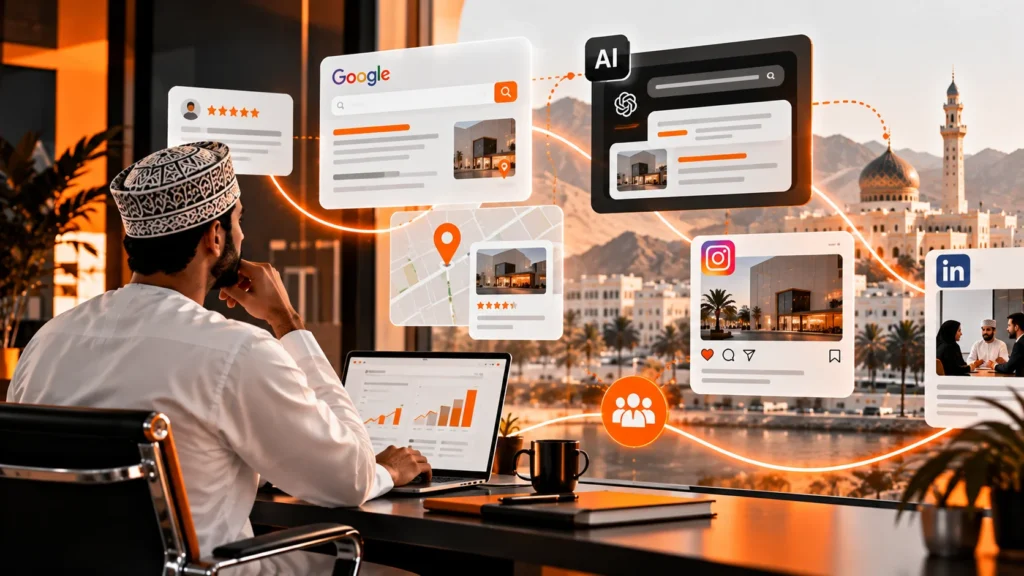
Imagine a customer in Muscat looking for a reliable company to provide a service. They search on Google, compare business profiles, read customer reviews, watch a short video, and ask an AI tool for recommendations. Before opening a single website, they already have an idea of which companies seem trustworthy. For every marketing agency, this change creates a new challenge: helping businesses become visible, useful, and credible wherever customers search, not only on their websites.
This doesn’t mean websites have lost their value. A website remains an important place to explain services, answer questions, and convert interest into enquiries. However, a modern marketing agency must understand that the customer journey often starts and develops across several digital platforms. The goal is no longer just to attract a website visit. It is to become a strong option when a customer is researching, comparing, and deciding.
What Happens When Customers Discover a Business Without Visiting Its Website?
A customer can discover a business through Google Search, Google Maps, social media, online reviews, videos, industry directories, and AI-generated answers. These platforms can help people understand what a company offers before they visit its website or contact its team. Consider someone searching for a marketing service in Muscat. They may see three companies in the search results:
| Business | Online presence |
|---|---|
| Company 1 | A clear business profile, recent reviews, useful articles, and examples of completed projects |
| Company 2 | An attractive website but very little information elsewhere |
| Company 3 | Regular social media posts but unclear service information |
The first company may earn more trust before the customer clicks anything. This is the kind of situation a marketing agency should prepare its clients for. Every public touchpoint can influence the customer’s first impression, even when that touchpoint does not generate a website session.
A useful question for business owners is: If a potential customer never visits your website, can they still understand what you do, who you help, and why they should trust you? If the answer is no, the business may be relying too heavily on one digital channel.
Why a Marketing Agency Must Look Beyond Website Traffic
Website traffic is useful, but it does not tell the whole story. A person may discover a company through a search result, check its reviews, return later through a direct visit, and then call. Standard website reports may show the final visit without revealing all the earlier interactions. A modern marketing agency should look at the complete customer journey rather than treating every channel as a separate activity.
Search visibility, social content, online reputation, paid campaigns, and website experience should support the same business goals. For example, a company may receive fewer website visits after improving its business profile and service information. That does not automatically mean its marketing performance has declined. If qualified calls and enquiries increase, the business may be reaching customers more effectively.
Measure Results According to the Business Model
| Business type | Important results to measure |
|---|---|
| Restaurant | Calls, directions, and table bookings |
| B2B service provider | Qualified leads, meeting requests, and sales opportunities |
| Online store | Purchases and repeat orders |
The role of a marketing agency is to connect visibility with business outcomes. Traffic still matters, but it should be understood alongside calls, form submissions, booked consultations, sales, and lead quality.
Can Customers Understand Your Business Without Your Website?
Use this practical test to check whether your business is ready for a more distributed discovery journey. Ask a colleague or someone unfamiliar with your company to research your brand without opening your website. Give them only your business name and ask them to find the following information.
| What to check | Questions to ask |
|---|---|
| Business identity | Can they find your correct company name, location, and contact details? |
| Service clarity | Can they understand what you offer and which customers you serve? |
| Trust signals | Can they find genuine reviews, professional credentials, case studies, or examples of your work? |
| Consistent information | Do your business profile, social pages, directories, and other listings describe the same company? |
| Useful content | Can they find answers to common questions about your services, process, or prices? |
| Easy contact | Is it clear how to call, message, request a quote, or book a consultation? |
| Measurable results | Can your team identify which channels contribute to calls and enquiries? |
A marketing agency can use this test as the starting point for an audit. It reveals gaps that a website-only review may miss.
For example, the website may list the correct phone number while an older directory still shows a previous number. A customer who finds the outdated listing may contact the wrong place or give up.
The test should also consider what appears when people search for your services rather than your company name. A business may be easy to find by brand name but almost invisible when a new customer searches for the problem it solves.
Why Being Visible Is Not the Same as Being Chosen
Visibility puts a business in front of a potential customer. Trust gives that customer a reason to consider it. Conversion makes it easier for the customer to take the next step. These are connected, but they are not the same.
A marketing agency may improve rankings or increase social media reach, yet enquiries can remain low if the content does not answer important questions. A customer might see a company in search results but find no clear service description, no evidence of experience, or conflicting information about its location.
Small Details That Help Build Trust
- A business profile has accurate opening hours.
- A service page explains what is included.
- A social post demonstrates real expertise.
- A review describes a specific customer experience.
- A company responds professionally to a question.
These details work together. They help customers decide whether a business looks relevant and reliable before they spend time contacting it.
Companies should avoid treating every online appearance as a sales message. Useful explanations, clear answers, real examples, and transparent information often provide more value than repeated promotional claims. A marketing agency should help the brand communicate evidence, not simply produce more content.
How a Marketing Agency Can Prepare a Business for AI Search
AI-powered search tools can answer questions by combining information from online sources. Depending on the tool and query, a person may receive a summary, a comparison, or suggestions before visiting any individual website. The exact sources and selection methods vary, and inclusion in an AI answer cannot be guaranteed.
This makes clear, reliable information increasingly important. A marketing agency should help businesses explain their services in language that both people and search systems can understand.
1. Create Clear Service Information
Any important service must have a dedicated page explaining what the service is, who needs it, what the process involves, and what outcomes it may support. Avoid vague descriptions that sound impressive but leave customers unsure about what the company actually does.
For example, a company offering business consulting should explain the types of organisations it supports, the problems it addresses, and how a typical engagement works. A marketing agency can structure this information around the real questions customers ask before choosing a provider.
2. Answer Specific Customer Questions
People search with detailed questions, such as “How long does a website redesign take?” or “What should a business prepare before starting an SEO campaign?” Useful answers can help a company become a stronger source of information.
A good answer should address the question directly, then add relevant details or an example. This approach supports human readers and makes key information easier for search systems to interpret. The purpose is to provide a genuinely helpful answer, not to repeat keywords in every sentence.
3. Keep Business Information Consistent
The company name, services, location, contact details, and other important facts should match across the website and trusted external profiles. A marketing agency should identify outdated listings and correct inaccurate information wherever the business has control.
Consistency does not mean copying identical text across every platform. Each platform can have a different purpose, but the facts about the business should remain accurate.
4. Support Important Claims With Evidence
If a company claims to have experience in a particular industry, it should provide evidence where possible. Examples include project descriptions, case studies, team expertise, certifications, and genuine customer feedback.
AI search visibility depends on many factors, and no agency can promise that a brand will always be cited. Still, clear information and credible evidence give people and search systems more useful material to evaluate.
SEO Still Matters When Customers Do Not Click
Search engine optimisation remains essential because search engines help people discover relevant businesses and information. SEO also improves the quality, structure, and usefulness of a website, making it easier for visitors to understand the offer when they do click. A marketing agency should begin with the following SEO fundamentals:
- Crawlability
- Indexation
- Useful content
- Descriptive page titles
- Internal links
- Mobile usability
- Page performance
A logical site structure. These elements help search engines access and interpret the information.
Create Content That Reflects Customer Searches
Content should reflect the language customers use. A business serving Oman may need pages that address:
- Specific services in Muscat
- Local customer needs
- The areas it can serve. Location pages should provide real value, not simply repeat the names of different cities.
Use Structured Data Accurately
Structured data can help search engines interpret suitable information about a business, product, service, or article. It must accurately represent the visible page content. Adding schema does not guarantee enhanced results or an AI citation, but it can clarify the information presented.
Keep Your Website as the Central Source
The website remains the central source that the business controls. Other platforms may change their layouts, policies, or visibility systems. A strong website gives the company a reliable place to:
- Publish detailed information
- Convert interest into action
Local Search and Google Maps: Important Touchpoints for Oman
For businesses serving a specific area, local discovery can be just as important as traditional organic rankings. A customer may search for a service near them, compare nearby providers, check reviews, and call directly from a business profile.
A marketing agency supporting an Omani business should review its Google Business Profile where eligible, including the business category, contact details, opening hours, service information, photographs, and review management process. The profile should represent the real business accurately and follow Google’s guidelines.
Local relevance also depends on the service itself. A company that works across Oman should explain its service coverage clearly. A business that only serves Muscat should not imply that it has a physical presence in every governorate.
Reviews need regular attention. Businesses should encourage genuine customers to share honest feedback, respond professionally, and use recurring comments to improve their service. Reviews should never be purchased or fabricated.
For example, a maintenance company may receive enquiries from people who discover it on Maps and call immediately. If the company measures only website form submissions, it may underestimate the value of local search. A marketing agency should help the client track relevant calls and enquiries where practical, while respecting privacy and platform limitations.
Social Media Helps Customers Judge Your Brand Before They Visit
Social platforms are not only places to publish promotions. Customers may use them to evaluate:
- How a business communicates
- What its work looks like
- Whether it understands its industry
- How it responds to people
Choose Platforms Based on Your Business Type
The best approach depends on the audience and business type.
| Business Type | Suitable Content |
|---|---|
| B2B consultancy | Useful LinkedIn content and expert explanations |
| Restaurant | Strong visual content, location details, menus, and customer experiences |
| Product-based company | Demonstrations and short videos that answer practical questions |
A marketing agency should choose platforms based on customer behaviour and business goals, not on the assumption that every company needs to be active everywhere. Regular posting has limited value if the content does not help the audience make a decision.
When Specialist Social Media Services Are Needed
For businesses that need a coordinated social presence, a specialist social media agency can support:
- Planning
- Publishing
- Community management
- Performance analysis
Brands that rely heavily on Instagram may also need dedicated Instagram management services to keep content, messages, and brand presentation consistent.
Measure Social Media Results Beyond Likes
Social media results should be judged beyond likes and follower counts. The following metrics can provide a clearer picture of value:
- Saves
- Meaningful comments
- Profile visits
- Qualified messages
- Website referrals
- Sales enquiries
The right metrics depend on what the company wants customers to do.
Paid Campaigns Must Connect With the Rest of the Customer Journey
Paid advertising can create visibility quickly, but an advert is only one part of the decision process. A person may:
- See an ad.
- Search for the brand.
- Read reviews.
- Compare providers.
- Contact the company days later.
A marketing agency should plan campaigns around the customer’s needs and the next step the business wants them to take. This includes choosing an appropriate audience, writing a clear message, setting up useful landing pages, and measuring meaningful actions.
Match the Advert to the Landing Page
Campaigns should also match the offer.
| Advert Promotes | What the Landing Page Should Provide |
|---|---|
| A consultation | Explain what the consultation includes and how to book it |
| A particular service | Help visitors find that service directly, without searching through a general homepage |
Connect Paid Advertising With the Wider Marketing Strategy
Understanding digital marketing vs digital advertising helps businesses see why paid promotion cannot replace the wider marketing system.
Advertising can help generate attention, while SEO, content, reputation, and customer experience support discovery and decision-making over time.
Coordinate Multi-Channel Campaigns
For more complex launches or multi-channel campaigns, a digital campaign agency can help coordinate:
- The message
- Creative assets
- Channels
- Measurement
The important point is to make each activity support the same commercial objective rather than running disconnected campaigns.
A Practical 30-Day Plan for Better Digital Discovery
Businesses do not need to rebuild every part of their marketing at once. A marketing agency can help prioritise the changes most likely to improve clarity, trust, and measurable enquiries.
Week 1: Audit Your Digital Presence
Search for your business name and main services. Review the following:
- Website
- Business profiles
- Social pages
- Directories
- Reviews
- Contact details
Record inaccurate information, missing pages, and unanswered customer questions.
Week 2: Improve Your Most Important Information
Update service pages, contact details, business descriptions, and local profiles. Make sure each priority service has:
- A clear explanation
- A defined audience
- An easy next step
Week 3: Publish Useful Proof and Answers
Create content that addresses real customer questions.
- Add project examples where permitted.
- Explain your process.
- Publish accurate information about your expertise.
- Avoid unsupported claims and generic articles that do not help the reader.
Week 4: Measure and Adjust
Review the following measures:
- Search performance
- Calls and enquiries
- Lead quality
- Social interactions
- Campaign results
Compare the data with your starting point and decide which gaps need attention next.
This first month is an audit and improvement cycle, not a promise of instant rankings or AI visibility. Some changes may produce early insights, while SEO and reputation improvements often require continued work.
A marketing agency should explain what it can measure, what remains uncertain, and which actions deserve priority.
How to Measure Results Beyond Website Clicks
The right measurement system should reflect how customers discover and contact the business. Website analytics are still useful, but they should be considered alongside other available data.
| Business Objective | Useful Measures |
|---|---|
| Improve organic discovery | Search impressions, relevant rankings, qualified organic visits |
| Increase local enquiries | Profile interactions, calls, direction requests where available |
| Build trust | Review quality, response rate, customer feedback |
| Generate social interest | Relevant reach, saves, meaningful messages, referral visits |
| Improve lead generation | Qualified enquiries, booked meetings, conversion rate |
| Support sales | Lead quality, opportunity value, customer acquisition cost |
Understand Attribution Limitations
A marketing agency should also explain attribution carefully. Customers may interact with several channels before contacting a company, and not every interaction can be tracked accurately.
Privacy settings, platform reporting limits, offline conversations, and cross-device activity can create gaps.
Combine Different Sources of Data
Use a combination of:
- Analytics
- All tracking where appropriate
- CRM records
- A simple question such as “How did you first hear about us?”
The answers will not be perfect, but they can reveal patterns that website data alone may miss.
Track Lead Quality Beyond Form Submissions
For B2B companies, tracking should continue beyond the initial form submission. A high number of leads is not useful if most are irrelevant.
Better reporting connects marketing activity to qualified opportunities and, where the sales cycle allows, revenue.
At Ground Z, businesses can explore a connected approach to digital visibility, content, social media, and campaign planning. The right starting point is a clear view of how customers currently find your company and where the biggest gaps exist.
Frequently Asked Questions About a Marketing Agency and AI Search
What does a marketing agency do when customers do not click websites?
A marketing agency helps a business improve its visibility and credibility across search results, local profiles, social platforms, useful content, and other relevant digital touchpoints. It also helps measure outcomes such as calls, qualified enquiries, and sales opportunities.
Is a website still important for SEO and AI search?
Yes. A website remains a valuable place to publish detailed service information, answer questions, show evidence of expertise, and convert interested customers. A marketing agency should strengthen the website while improving the company’s wider digital presence.
How can a business improve its chances of appearing in AI search answers?
Publish accurate, useful information, answer specific customer questions, maintain consistent business details, and support important claims with credible evidence. A marketing agency can improve these foundations, but no provider can guarantee inclusion in every AI-generated answer.
Does every company in Oman need to be on every social media platform?
No. The right platform mix depends on the audience, industry, service, and business goals. A marketing agency should select channels based on evidence and customer behaviour rather than trying to maintain a presence everywhere.
How can a business measure customers who discover it without clicking?
Use the data available from search tools, business profiles, social platforms, call tracking, CRM records, and customer feedback. A marketing agency should combine these signals carefully because no single report captures every interaction.
How long does it take to improve digital visibility?
The timeline depends on the starting point, competition, website quality, reputation, and the actions taken. Paid campaigns can generate exposure sooner, while SEO and reputation-building often require sustained effort. A responsible marketing agency will set realistic milestones and review progress regularly.
What should a business look for when choosing a marketing agency?
Look for a clear strategy, relevant experience, transparent reporting, realistic expectations, and a strong understanding of your customers. A good marketing agency should explain how its work connects to business outcomes, not only rankings, impressions, or follower counts.
Ground Z helps businesses build a more connected digital presence through strategy, search visibility, content, and digital campaigns. If your business wants to improve how customers discover and evaluate it online, contact Ground Z to discuss your current digital presence and identify the next practical steps.