If you ask what is digital marketing, the simplest answer is this: digital marketing is the use of digital technologies, platforms, data, and communication channels to connect a business with potential and existing customers, influence their decisions, generate demand, and support measurable business outcomes. It includes websites, search engines, social media, email, online advertising, mobile applications, digital content, analytics, and other digital touchpoints.
But that definition is only the starting point. In 2026, digital marketing is no longer simply about putting advertisements on the internet. Customers now discover businesses through search engines, social platforms, videos, websites, recommendations, and increasingly through AI-powered search and answer systems. At the same time, marketers have access to more data, automation, artificial intelligence, and measurement tools than ever before.
That creates a more interesting question: What is digital marketing when the way people discover information is changing?
This guide explains the concept from a practical and scientific perspective. It covers how digital marketing developed, how its main channels work, how customers move through a digital journey, the role of data and technology, and how artificial intelligence is changing digital marketing in 2026.
What Is Digital Marketing? A Clear Scientific Definition
Digital marketing is a marketing discipline that uses digital technologies and channels to communicate value to defined audiences and influence measurable customer or business actions.
This definition contains several important ideas.
First, digital marketing is still marketing. The fundamental purpose has not changed. A company still needs to understand:
- Who its customers are.
- What problem they have.
- What value the company provides.
- Why customers should choose it.
- How the buying decision happens.
- What makes customers stay.
What has changed is the environment in which these activities happen.
Instead of depending mainly on newspapers, billboards, radio, brochures, and television, businesses can now communicate through websites, search engines, social networks, email, mobile applications, video platforms, digital advertising systems, and other connected technologies.
This is why digital marketing should not be reduced to “posting on social media.” Social media is only one part of a much larger system.
What Is Digital Marketing and How Is It Different From Traditional Marketing?
Traditional marketing and digital marketing share the same basic commercial purpose: connecting an organization with an audience. The main difference lies in the environment, data, interaction, and measurement.
Consider a billboard. A company can estimate how many people may see it, but it usually cannot identify every person who looked at it or know exactly what they did afterward.
With an online campaign, marketers may be able to see:
- How many people received an impression
- How many clicked
- Which audience segments responded
- Which device they used
- Which landing page they visited
- Whether they completed a form
- Whether they purchased
- How much the acquisition cost
This feedback loop is one of the defining characteristics of modern digital marketing. It allows marketers to observe behavior and adjust campaigns based on evidence rather than relying entirely on assumptions.
Digital marketing platforms also make targeting, personalization, and measurement possible at a level that traditional media often cannot provide.
However, digital does not automatically mean better. A poorly targeted digital advertisement can waste money just as quickly as a poorly planned traditional advertisement.
Technology gives marketers more control. It does not remove the need for good marketing decisions.
What Is Digital Marketing in Simple Terms?
If the scientific definition feels too formal, a practical definition is: Digital marketing is how a business uses digital channels to become visible, communicate with people, create interest, generate customers, and maintain relationships with them.
Imagine a restaurant in Muscat.
A potential customer may search for a restaurant, see a search result, visit the website, check Instagram, read reviews, watch a short video, send a message, and make a reservation.
Later, the same customer may receive an offer through email or another digital channel. Every one of these interactions can form part of digital marketing.
The customer does not experience these activities as separate marketing departments. They experience one customer journey.
That distinction is important when planning a digital marketing strategy.
What Is Digital Marketing Made Of?
Digital marketing is an umbrella term that includes multiple disciplines. These activities can work independently, but they often work better together.
| Digital Marketing Area | Main Role |
|---|---|
| Search Engine Optimization | Improve organic search visibility |
| Paid Search Advertising | Reach people through paid search campaigns |
| Social Media Marketing | Build visibility and engagement through social platforms |
| Content Marketing | Educate and inform audiences through useful content |
| Email Marketing | Communicate with and nurture audiences |
| Display Advertising | Reach audiences through digital advertising placements |
| Video Marketing | Communicate through video content |
| Influencer Marketing | Reach audiences through relevant creators |
| Affiliate Marketing | Generate results through external partners |
| Mobile Marketing | Reach users through mobile-focused channels |
| Marketing Automation | Automate selected marketing activities |
| Conversion Optimization | Help more visitors complete desired actions |
| Analytics and Measurement | Track performance and customer behavior |
| Digital CRM | Manage digital customer relationships |
Different sources may group these disciplines differently, but the central idea remains the same: digital marketing covers a broad set of digital channels and techniques used to reach and engage audiences.
What Is Digital Marketing Through the Customer Journey?
One of the easiest ways to understand digital marketing is to stop thinking only about channels and start thinking about the customer.
A potential customer may move through several stages:
- Awareness
- Interest
- Research
- Evaluation
- Decision
- Purchase
- Retention
Digital marketing can support each stage.
| Customer Stage | What Happens |
|---|---|
| Awareness | The person discovers that a company exists |
| Interest | The person becomes curious about its products or services |
| Research | The person looks for more information |
| Evaluation | The person compares alternatives |
| Decision | The person decides whether to contact or purchase |
| Retention | The company works to keep the customer |
This is why a business should not judge every digital marketing activity using the same metric.
The same criteria should not necessarily judge a video designed for awareness as a landing page designed to generate leads.
The role of each activity should be understood within the larger customer journey.
What Is Digital Marketing and How Is It Different From Traditional Marketing?
Traditional marketing and digital marketing share the same basic commercial purpose: connecting an organization with an audience. The main difference lies in the environment, data, interaction, and measurement.
Consider a billboard. A company can estimate how many people may see it, but it usually cannot identify every person who looked at it or know exactly what they did afterward.
With an online campaign, marketers may be able to see:
- How many people received an impression
- How many clicked
- Which audience segments responded
- Which device they used
- Which landing page they visited
- Whether they completed a form
- Whether they purchased
- How much the acquisition cost
This feedback loop is one of the defining characteristics of modern digital marketing. It allows marketers to observe behavior and adjust campaigns based on evidence rather than relying entirely on assumptions.
Digital marketing platforms also make targeting, personalization, and measurement possible at a level that traditional media often cannot provide.
However, digital does not automatically mean better. A poorly targeted digital advertisement can waste money just as quickly as a poorly planned traditional advertisement.
Technology gives marketers more control. It does not remove the need for good marketing decisions.
What Is Digital Marketing Through Social Media?
Social media marketing uses social platforms to communicate with audiences, build communities, distribute content, generate attention, support sales, and maintain relationships.
Social platforms can serve several purposes:
- Brand awareness.
- Community building.
- Customer support.
- Content distribution.
- Product discovery.
- Paid advertising.
- Lead generation.
- Reputation building.
The important point is that social media is not one single marketing tactic.
A business can use Instagram for visual discovery, LinkedIn for professional communication, TikTok for short-form video, or other platforms according to the audience and business objective.
For companies operating in Oman, a specialized social media marketing agency in Oman can help connect platform selection, content, advertising, and audience behavior rather than simply increasing the number of posts.
What Is Digital Marketing Through Content?
Content marketing is closely related to digital marketing but is not the same thing. Content marketing focuses on creating and distributing useful information for a defined audience.
Examples include:
- Articles.
- Guides.
- Videos.
- Case studies.
- Research.
- Tutorials.
- Webinars.
- Comparison pages.
- Product explanations.
- Frequently asked questions.
This is where the distinction between digital marketing vs content marketing becomes useful.
- Digital marketing is the wider field.
- Content marketing is one part of that field.
A company can use content without running paid advertising. It can also promote that content through paid advertising. The two approaches can therefore work together.
What Is Digital Marketing Through Email?
Email is one of the oldest major digital marketing channels, but it remains useful because the company can communicate directly with people who have chosen to provide an email address.
Email can be used for:
- Newsletters.
- Product announcements.
- Offers.
- Educational content.
- Lead nurturing.
- Customer onboarding.
- Renewal reminders.
- Retention.
- Automated journeys.
The key advantage is that email can support an ongoing relationship. A social platform controls much of the environment.
An email database can become an important owned audience, provided the business collects and uses data responsibly.
What Is Digital Marketing Through Paid Advertising?
Paid digital advertising allows companies to buy exposure across digital platforms.
Common forms include:
- Search ads
- Social media ads
- Display advertising
- Video advertising
- Retargeting
- Shopping ads
- Sponsored content
The basic model is simple: a company has an audience and an objective, then pays a platform or publisher to reach people who fit certain criteria.
The campaign then generates data that can be analyzed and used to improve performance.
Modern advertising systems can use many signals for optimization, but businesses should still consider privacy, consent, data quality, and measurement when planning and evaluating campaigns.
What Is Digital Marketing Through Data?
Data is one of the features that makes modern digital marketing different from many traditional marketing methods.
Companies can collect and analyze information such as:
| Data Type | Example |
|---|---|
| Website activity | Visits and page interactions |
| Campaign interactions | Clicks and ad engagement |
| Purchases | Transactions and order behavior |
| Form submissions | Lead and inquiry data |
| Email behavior | Opens and clicks |
| Customer preferences | Interests and preferences |
| Product usage | How customers use a product or service |
| Advertising responses | Responses to different campaigns |
However, data is only useful when it is accurate and used responsibly.
A large database does not automatically create a good marketing strategy. Poor-quality data can lead to poor targeting and weak decisions.
This is one reason first-party data has become increasingly important. Experian’s 2026 research highlights first-party data activation as a foundational capability and reports that 70% of B2B marketers plan to increase their use of first-party data.
What Is Digital Marketing in 2026?
In 2026, the basic definition of digital marketing remains the same, but the environment around it has changed significantly.
Three developments are particularly important:
- Artificial intelligence is becoming part of everyday marketing workflows.
- Search is expanding into AI-powered answer and discovery experiences.
- First-party data and privacy are becoming increasingly important.
Technology is changing the way marketing is executed, but the fundamental questions remain:
Who is the customer?
What does the customer need?
Why should the customer choose this company?
What action should happen next?
This distinction is important because AI can change how marketing is produced, but it does not remove the need for strategy.
What Is Digital Marketing in the Age of Artificial Intelligence?
Artificial intelligence is now involved in many areas of digital marketing, including:
- Audience analysis
- Content research
- Copy drafting
- Creative variations
- Data analysis
- Campaign optimization
- Customer segmentation
- Forecasting
- Personalization
- Customer support
- Workflow automation
Research published for 2026 shows that marketers are moving beyond simple AI experimentation toward broader operational use. Experian reports that 94% of marketers surveyed are investing broadly in AI for efficiency and impact.
However, wider AI adoption also creates an important challenge.
If companies use the same tools to produce similar content, creating more content does not necessarily create more value.
Human expertise therefore remains important for:
| Area | Role |
|---|---|
| Original insights | Bringing unique ideas and perspectives |
| Brand judgment | Maintaining the right brand direction |
| Accuracy | Reviewing information and avoiding errors |
| Context | Understanding the specific market and audience |
| Strategy | Connecting activities with business objectives |
| Customer understanding | Recognizing real customer needs |
| Creative direction | Deciding what should be created and why |
In other words, AI can increase production capacity, but it does not automatically increase marketing quality.
What Is Digital Marketing and What Is GEO?
GEO refers broadly to optimizing information so that generative AI and answer engines can understand, retrieve, and potentially reference it.
The goal is not simply to rank a webpage in a traditional list.
The goal is to make information useful and understandable within systems that generate answers.
For example, a company might publish a page answering:
“What services does a digital marketing agency provide?”
A well-structured answer could clearly explain:
- Strategy.
- Advertising.
- Social media.
- Content.
- Analytics.
- Lead generation.
This structure helps both human readers and information-retrieval systems.
Generative Engine Optimization does not replace traditional SEO.
They overlap.
The broader principle is simple:
Create information that is genuinely useful, clearly organized, and easy for machines and humans to understand.
What Is Digital Marketing and Why Does First-Party Data Matter?
Privacy is changing how businesses collect and use customer information.
First-party data is information a company collects directly from its own interactions with customers or prospects.
Examples include:
- Website registrations.
- Customer purchases.
- Email subscriptions.
- CRM records.
- Customer preferences.
- Direct inquiries.
- Account activity.
This data can help a company understand its audience without depending entirely on external audience databases.
Experian’s 2026 research specifically points to first-party data activation and privacy-safe audience management as major capabilities for modern marketing teams.
The lesson is not “collect everything.”
The lesson is:
Collect useful information responsibly and understand why you need it.
What Is Digital Marketing Without Good Measurement?
Digital marketing creates a large amount of measurable activity.
But measurement can become dangerous when businesses track everything except what matters.
Imagine a company reports:
- 2 million impressions.
- 80,000 views.
- 30,000 clicks.
That sounds impressive.
Then the sales team reports:
Seven qualified opportunities.
The marketing report and business report may tell very different stories.
This is why digital marketing measurement should connect activity to business outcomes.
Depending on the business, important metrics can include:
- Qualified leads.
- Cost per qualified lead.
- Conversion rate.
- Revenue.
- Customer acquisition cost.
- Return on advertising spend.
- Customer lifetime value.
- Retention rate.
What Is Digital Marketing and What Is a Conversion?
A conversion is a desired action completed by a user.
The action depends on the business.
For an e-commerce store:
Purchase = conversion
For a B2B company:
Qualified lead = possible conversion
For a restaurant:
Reservation = conversion
For a software company:
Demo request = conversion
For a newsletter:
Subscription = conversion
This is why there is no universal “best digital marketing metric.”
The correct metric depends on what the company wants the customer to do.
What Is Digital Marketing for B2B Companies?
B2B marketing can be more complex because several people may influence a purchase.
A software purchase might involve:
- A technical manager.
- A department head.
- Procurement.
- Finance.
- Senior management.
- IT security.
Each person may ask different questions.
That is where structured B2B digital marketing solutions can become useful.
A B2B strategy may combine:
- Educational content.
- LinkedIn campaigns.
- Search marketing.
- Email.
- Webinars.
- Case studies.
- Landing pages.
- Lead qualification.
- CRM integration.
- Retargeting.
The goal is not simply to get more website visitors.
The goal is to create the right commercial conversations.
What Is Digital Marketing for Small Businesses?
Small businesses often face a different problem.
They do not necessarily have:
- Large marketing teams.
- Large budgets.
- Dedicated analysts.
- Multiple content creators.
- Marketing automation specialists.
That means the strategy should be focused.
A small business may get better results from doing three things properly than attempting fifteen activities poorly.
For example:
- One strong website
- One relevant social platform
- One focused advertising campaign
can be more useful than managing five social accounts with no clear objective.
What Is Digital Marketing for Local Businesses?
Local businesses often depend heavily on geographic intent.
Consider searches such as:
- Restaurant in Muscat.
- Dental clinic in Oman.
- Digital marketing agency in Muscat.
- Hotel near a specific location.
- Car service near me.
In these cases, location becomes part of the marketing message.
A local digital marketing strategy may therefore involve:
- Location-based advertising.
- Local search visibility.
- Reviews.
- Maps.
- Social media.
- Local landing pages.
- Community content.
For businesses operating in Oman, working with a local marketing agency in Oman can be useful when the strategy requires knowledge of the local market as well as digital execution.
What Is Digital Marketing for Brand Building?
Digital marketing is not only about immediate sales.
It can also build brand memory.
A person may see a company several times before becoming a customer.
One day they watch a video.
Another day they read an article.
Later they see an advertisement.
Then a colleague mentions the company.
Eventually, they search for it.
This is not always a clean, linear funnel.
Real customer journeys are often messy.
That is why brand-building activities can influence performance even when they do not generate an immediate conversion.
What Is Digital Marketing and Why Does Creative Matter?
Creative content has become increasingly important because audiences are exposed to large amounts of information.
A campaign can have precise targeting and still fail if the message does not attract attention.
Creative work includes:
- Images.
- Videos.
- Headlines.
- Product demonstrations.
- Stories.
- Motion graphics.
- Visual identity.
- Ad concepts.
For companies that require high-quality visual execution, a digital production agency can support the production side of campaigns.
But production should always connect back to the marketing objective.
A beautiful video with no clear audience or purpose is still a weak marketing asset.
What Is Digital Marketing and How Does It Affect Customer Behavior?
Digital marketing can influence behavior in several ways.
It can increase awareness
People become aware of a company or product.
It can reduce uncertainty
Useful information can answer questions.
It can create urgency
An offer or limited-time campaign may encourage action.
It can build trust
Reviews, case studies, and expert content can reduce perceived risk.
It can simplify decisions
Clear comparison and product information can make choices easier.
It can create reminders
Retargeting and email can bring a product back to someone’s attention.
The effect depends on the message, timing, audience, product, and context.
What Is Digital Marketing and How Does It Influence the Buying Decision?
A buying decision rarely depends on one advertisement.
People may consider:
- Price.
- Quality.
- Reviews.
- Reputation.
- Convenience.
- Availability.
- Trust.
- Alternatives.
- Previous experiences.
Digital marketing can influence several of these factors.
For example:
- A case study can provide proof.
- A product video can demonstrate functionality.
- A review can reduce uncertainty.
- A comparison page can help evaluation.
- An advertisement can create awareness.
- A simple checkout can reduce friction.
This is why digital marketing is better understood as a system of interactions rather than a collection of advertisements.
What Is Digital Marketing and Why Does Personalization Matter?
Personalization means adjusting communication based on relevant information about the audience.
It can be simple.
For example: An email can use a customer’s name.
Or it can be more advanced.
A company may show different recommendations based on:
- Previous purchases.
- Industry.
- Location.
- Website behavior.
- Product interest.
But personalization should be useful.
Showing someone’s name in every sentence is not meaningful personalization.
The best personalization helps the customer find information or products that are more relevant to them.
What Is Digital Marketing and What Role Does Automation Play?
Automation allows repetitive marketing tasks to happen according to predefined rules.
Examples include:
- Welcome emails.
- Lead notifications.
- Customer reminders.
- Campaign reporting.
- Audience segmentation.
- Follow-up sequences.
- Abandoned-cart messages.
Automation can save time.
But automation should not mean removing human judgment.
A customer with a complicated complaint should not receive an automated message telling them to “click here to learn more.” Good automation handles predictable situations.
People should handle situations requiring judgment, empathy, negotiation, or deeper understanding.
What Is Digital Marketing and How Has It Evolved?
Digital marketing did not appear fully formed.
Its development happened through several stages.
Early internet era
Businesses began creating websites and using email.
Search era
Search engines became major gateways to information.
Social era
Social platforms changed communication and content distribution.
Mobile era
Smartphones made digital interaction continuous and location-aware.
Data era
Analytics and audience targeting became more sophisticated.
Automation era
Marketing software automated many repetitive activities.
AI era
Generative and predictive AI began influencing research, content, analysis, personalization, and search.
The industry is still changing.
What Is Digital Marketing in the Mobile-First Era?
Mobile devices changed customer behavior.
People can now:
- Search while walking.
- Compare products inside stores.
- Watch videos during short breaks.
- Message businesses instantly.
- Purchase without using a computer.
- Receive location-based information.
This makes convenience important.
A mobile user may abandon a page that loads slowly.
They may avoid a form with too many fields.
They may prefer a messaging option over a long contact process.
Digital marketing therefore includes not only communication but also experience design.
What Is Digital Marketing and What Is Omnichannel Marketing?
Omnichannel marketing connects customer experiences across different channels.
A customer might:
- See an advertisement.
- Visit the website.
- Follow the brand on social media.
- Receive an email.
- Return to the website.
- Contact sales.
- Purchase.
If every interaction feels disconnected, the customer may become confused.
If the information is consistent, the experience becomes easier.
Omnichannel marketing does not mean being everywhere.
It means making relevant channels work together.
What Is Digital Marketing and Why Does Customer Experience Matter?
Marketing does not stop when someone clicks an advertisement.
The experience after the click matters.
Suppose an advertisement promotes a specific product.
The customer clicks.
The website shows something completely different.
The visitor may leave.
This is a basic example of message mismatch.
Good digital marketing creates continuity between:
- Ad
- Landing Page
- Product Information
- Action
- Follow-up
Each step should make sense relative to the previous one.
What Is Digital Marketing and What Is the Role of a Marketing Agency?
A marketing agency can help a business plan, execute, measure, and improve digital marketing activities.
The exact role depends on the agency.
Services may include:
- Strategy.
- Advertising.
- Social media.
- Content.
- Website development.
- Creative production.
- Analytics.
- Lead generation.
- Brand development.
A good agency should not simply ask:
“How many posts do you want?”
It should first ask:
“What business result are we trying to achieve?”
That question changes the entire strategy.
What Is Digital Marketing and When Should a Business Hire an Agency?
An agency can become useful when:
- The internal team lacks specific expertise.
- Campaigns are becoming difficult to manage.
- Advertising spend is increasing.
- The company needs multiple channels.
- Measurement is unclear.
- The business is entering a new market.
- Creative production is becoming a bottleneck.
- Lead generation needs improvement.
Hiring an agency is not automatically the right choice.
The business should first understand what problem it wants the agency to solve.
What Is Digital Marketing and What Should Ground Z Do for a Business?
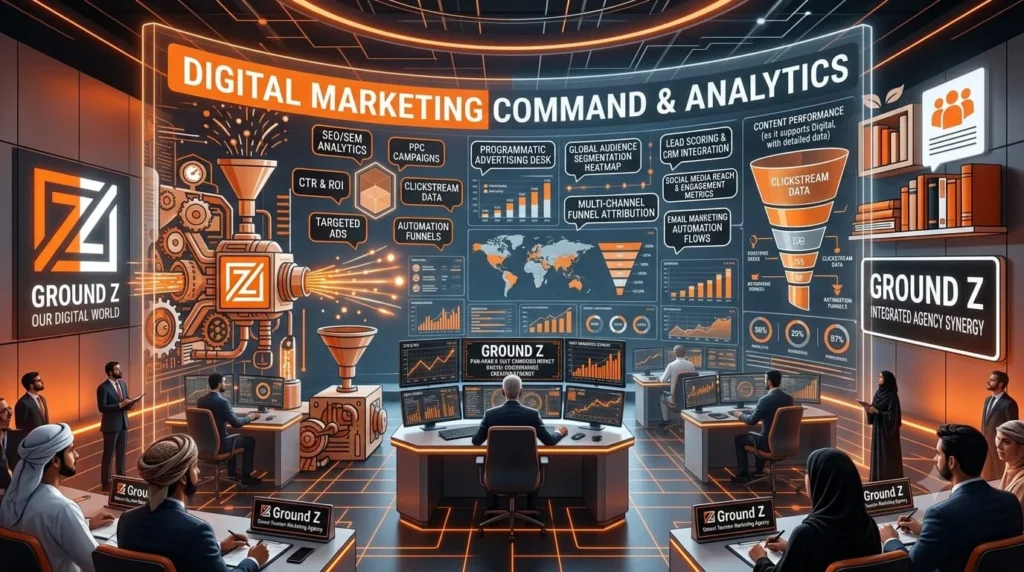
Ground Z can approach digital marketing as a connected business process rather than treating each channel as an isolated task.
For a company in Oman, that may involve understanding:
- The target market.
- The customer.
- The offer.
- The competitive environment.
- The most suitable digital channels.
- The content required.
- The advertising opportunities.
- The measurement system.
The right combination will be different for a restaurant, technology company, professional service, retailer, or B2B organization.
If your business needs a practical digital marketing strategy built around its actual goals, talk to Ground Z and request a customized digital marketing plan for your business.
What Is Digital Marketing and What Are the Main Benefits?
Digital marketing can provide several business advantages.
Measurability
Businesses can track many interactions and outcomes.
Targeting
Campaigns can be directed toward defined audiences.
Flexibility
Digital campaigns can often be adjusted faster than traditional campaigns.
Reach
A business can reach people beyond its immediate physical location.
Interaction
Customers can communicate directly with businesses.
Personalization
Messages can be adapted to relevant customer information.
Testing
Businesses can compare different messages, audiences, offers, and creative approaches.
These advantages are powerful, but they depend on execution.
What Is Digital Marketing and What Are Its Limitations?
Digital marketing is not a magic solution.
There are important limitations.
Competition is high
Many businesses compete for the same attention.
Platforms change
Algorithms, policies, and advertising systems evolve.
Data can be misleading
Large numbers do not always represent business value.
Privacy matters
Businesses must handle customer data responsibly.
Creative quality matters
Poor messages can fail even with good targeting.
Customer behavior is complex
People do not always follow a predictable funnel.
Technology can create complexity
More tools do not necessarily mean better marketing.
Good strategy is therefore still essential.
What Is Digital Marketing and How Should a Business Build a Strategy?
A practical strategy can follow this sequence.
1. Define the business goal
Do you want:
- More sales?
- More leads?
- More customers?
- Better retention?
- More awareness?
2. Define the audience
Understand:
- Who they are.
- What they need.
- What they fear.
- What influences them.
- Where they look for information.
3. Define the offer
Explain clearly:
- What are you selling?
- Why does it matter?
- Why should customers choose you?
4. Choose channels
Do not select channels simply because competitors use them.
Choose channels based on audience behavior and business goals.
5. Create the message
The message should address a real customer need.
6. Build the customer journey
Decide what happens after someone sees the campaign.
7. Measure
Choose metrics connected to the objective.
8. Improve
Use the data to make better decisions.
What is a marketing agency in Oman?
Digital marketing in Oman follows the same fundamental principles as digital marketing elsewhere, but execution should reflect the local market.
A company operating in Oman may need to consider:
- Local customer behavior.
- Arabic and English communication.
- Geographic targeting.
- Cultural context.
- Local purchasing habits.
- Business sectors.
- Local competition.
- Platform preferences.
A campaign designed for a global audience should not automatically be copied into the Omani market.
Local relevance matters.
What Is Omani B2B Digital Marketing Solutions?
A B2B company in Oman may have a smaller but more specialized audience.
For example, a technology supplier may target:
- CIOs.
- IT managers.
- Procurement teams.
- Business owners.
- Government-related organizations.
- Enterprise decision-makers.
The campaign should therefore focus on relevance rather than raw reach.
A thousand highly relevant decision-makers can be more commercially useful than one hundred thousand random impressions.
What Is Digital Marketing in 2026: The Role of First-Party Data
First-party data is becoming more important because businesses need stronger control over their customer relationships and measurement.
A company can build useful first-party data through:
- Website forms.
- Customer accounts.
- Email subscriptions.
- Purchases.
- CRM systems.
- Direct inquiries.
- Customer feedback.
The objective should not be to collect unnecessary information.
The objective is to understand customers better while respecting privacy and consent.
What Is Digital Marketing in 2026: AI-Assisted Content
AI can help marketers produce content faster.
For example, it can assist with:
- Research organization.
- Draft structures.
- Content variations.
- Data analysis.
- Creative concepts.
- Audience segmentation.
But faster production creates another challenge.
The internet can become filled with similar material.
This makes originality more valuable.
A company that publishes generic information may be less useful than a company that provides:
- Original research.
- Real examples.
- Expert opinions.
- Local insights.
- First-hand experience.
- Specific data.
- Clear comparisons.
The competitive advantage is not simply using AI.
It is knowing what to do with it.
What Is Digital Marketing in 2026: AI and Human Expertise
The strongest model is not necessarily:
Human vs AI
It is: Human expertise + AI capability
AI is good at processing large amounts of information and helping with repetitive work.
Humans are still needed for:
- Strategic judgment.
- Brand decisions.
- Context.
- Ethics.
- Relationships.
- Creative direction.
- Business understanding.
Recent 2026 research also highlights the importance of human-centered data and responsible AI use as organizations expand AI across marketing operations.
What Is Digital Marketing in 2026: Why Trust Matters More
As AI-generated content and automated interactions become common, customers may become more careful about what they believe.
That makes trust more important.
Businesses can build trust through:
- Clear information.
- Transparent pricing.
- Customer reviews.
- Real examples.
- Expert authorship.
- Original research.
- Consistent brand communication.
- Responsive customer service.
Technology can increase the speed of communication.
Trust determines whether people believe that communication.
What Is Digital Marketing and How Does It Create Business Value?
Digital marketing creates business value when digital interactions lead to useful commercial outcomes.
These can include:
- New customers.
- Qualified leads.
- Higher repeat purchases.
- Lower acquisition costs.
- Greater customer retention.
- Stronger brand recognition.
- Better customer relationships.
The path may be direct or indirect.
- A paid advertisement might create a direct purchase.
- A research article might influence someone who buys several months later.
- A brand video might make a company more recognizable.
This is why measurement should include both short-term and longer-term effects.
Frequently Asked Questions About What Is Digital Marketing
What is digital marketing in simple words?
Digital marketing is the use of digital channels such as websites, search engines, social media, email, mobile platforms, and online advertising to reach customers, communicate with them, and support business goals.
What are the main types of digital marketing?
The main types include search marketing, paid advertising, social media marketing, content marketing, email marketing, video marketing, influencer marketing, affiliate marketing, mobile marketing, automation, and analytics.
Is digital marketing the same as online marketing?
The terms are often used interchangeably. Online marketing usually refers specifically to activities delivered through the internet, while some definitions of digital marketing are broader and include digital technologies beyond internet-based channels.
What is digital marketing in 2026?
In 2026, digital marketing includes traditional digital channels such as search, social media, email, websites, and advertising, but it is increasingly influenced by AI, AI-powered search, automation, first-party data, privacy requirements, and more connected measurement systems.
Is SEO part of digital marketing?
Yes. SEO is one of the major disciplines within digital marketing. It focuses on improving a website’s ability to appear for relevant organic search queries.
Is social media marketing part of digital marketing?
Yes. Social media marketing is one of the main digital marketing disciplines. It can include organic content, community management, social advertising, influencer activity, and lead generation.
What is the difference between digital marketing and content marketing?
Digital marketing is the broader discipline. Content marketing is a specific approach that uses useful and relevant content to attract, educate, engage, and support an audience.
Do small businesses need digital marketing?
Most businesses can benefit from having a digital presence, but the exact strategy depends on the business model, audience, location, budget, and goals. A small business does not need to use every digital channel.
How does AI affect digital marketing?
AI can help with research, content creation, personalization, analytics, campaign optimization, automation, and customer interaction. In 2026, its role is expanding from isolated experiments toward everyday marketing workflows.
Can AI replace digital marketers?
AI can automate some marketing tasks, but it does not remove the need for strategy, business understanding, creative judgment, ethical decisions, and human relationships. The more useful approach is usually to combine AI capabilities with human expertise.
What is GEO in digital marketing?
GEO, or Generative Engine Optimization, refers broadly to improving online information so that AI-powered search and answer systems can understand and potentially reference it when generating responses.
Does digital marketing work without paid advertising?
Yes. Businesses can use organic search, social media, email, content, referrals, communities, and other channels without paying for advertising. However, paid advertising can provide faster distribution when it is properly targeted.
How long does digital marketing take to produce results?
There is no single timeline. Paid campaigns can produce traffic quickly, while content, organic search visibility, brand awareness, and customer relationships often take longer. Results depend on the market, offer, competition, budget, execution, and measurement.
How can Ground Z help with digital marketing?
Ground Z can help businesses plan and execute digital marketing activities based on their market, audience, business objectives, and required channels. The appropriate mix may include strategy, social media, advertising, content, creative production, and performance measurement. For businesses in Oman that need a structured digital marketing approach, Ground Z can develop a plan based on the specific business situation.
Need a digital marketing strategy built around your actual business goals? Talk to Ground Z and request a customized plan for your company.