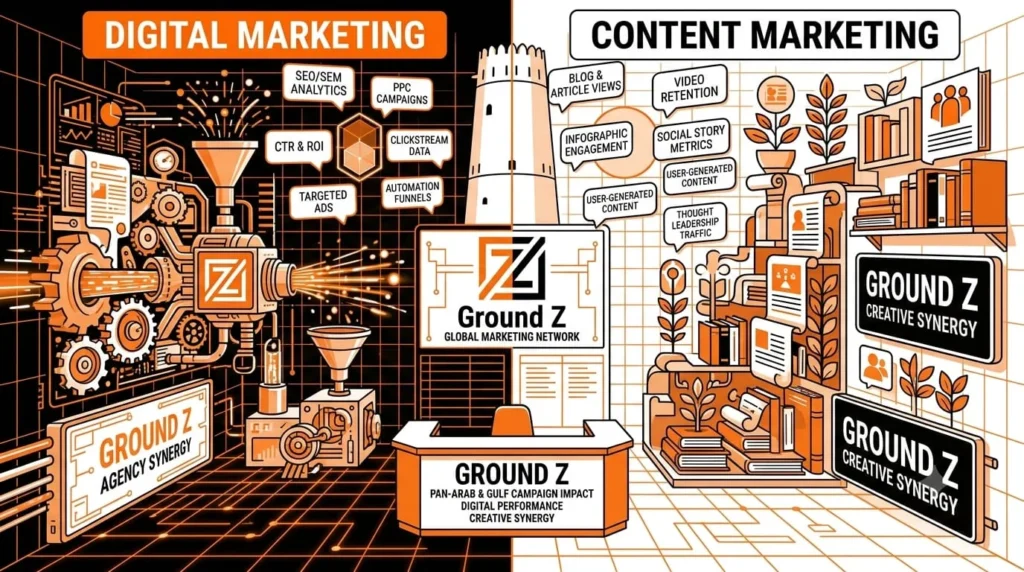
When comparing digital marketing vs content marketing, the biggest mistake is treating them as two competing strategies. Content marketing is actually one part of digital marketing. Digital marketing covers a much wider range of activities, including paid advertising, social media, email, websites, search, analytics, and other digital channels. Content marketing focuses mainly on creating and distributing useful content that attracts, educates, and builds trust with a specific audience.
A B2B technology company may need content to explain a complex product, paid campaigns to reach decision-makers, social media to build credibility, email to nurture leads, and a strong website to convert interest into sales. In that situation, choosing between digital marketing and content marketing does not make much sense. The two work together.
This guide explains the difference between digital marketing vs content marketing, what each strategy includes, when to use each one, how they work together, what they cost, how results should be measured, and how businesses can choose the right approach.
Digital Marketing vs Content Marketing: The Short Answer
Digital marketing is the wider strategy. Content marketing is one component inside it.
Digital marketing uses digital channels and tactics to attract, engage, convert, and retain customers. Content marketing uses valuable and relevant content to attract a defined audience and help move that audience toward a business goal.
A simple way to understand the relationship is:
Digital Marketing
- Content Marketing
- Social Media Marketing
- Paid Advertising
- Email Marketing
- Website Marketing
- Search Marketing
- Conversion Optimization
- Analytics
- Marketing Automation
So, when discussing digital marketing vs content marketing, it is more accurate to think about a broad system versus one important part of that system.
Digital Marketing vs Content Marketing: What Is Digital Marketing?
Digital marketing is the use of digital channels and technologies to promote a business, communicate with customers, generate demand, and support sales.
It can include both organic and paid activities.
A digital marketing strategy may use:
- Websites
- Search engines
- Social media
- Online advertising
- Video
- Content
- Landing pages
- Marketing automation
- Analytics
- Retargeting
- Digital partnerships
The exact mix depends on the business.
A local restaurant may need a very different digital marketing strategy from a B2B software company.
A restaurant may focus heavily on:
- Instagram.
- Short videos.
- Local advertising.
- Reviews.
- Offers.
- Maps and location-based discovery.
A B2B software company may focus more on:
- Educational content.
- LinkedIn.
- Lead generation.
- Email.
- Webinars.
- Product demonstrations.
- Case studies.
- Account-based campaigns.
The term “digital marketing” therefore describes a large field rather than one specific activity.
Content Marketing vs Digital Marketing: What Is Content Marketing?
Content marketing is the planned creation and distribution of useful content for a specific audience. The purpose is not simply to publish more material, but to provide information that answers questions, solves problems, explains products, reduces uncertainty, or helps people make better decisions.
Content marketing can include:
- Blog articles
- Videos
- Guides
- Case studies
- White papers
- Reports
- Infographics
- Social media posts
- Podcasts
- Webinars
- Product explainers
- Email content
- Comparison pages
- Frequently asked questions
For example, imagine a company sells cybersecurity software. A direct advertisement might say: “Protect your business with our cybersecurity solution.”
Content marketing could instead create: “10 Common Cybersecurity Risks for Growing Companies”
The second piece does not immediately ask the reader to buy. It helps the reader understand a problem, and that is an important difference.
Digital Marketing vs Content Marketing: The Main Difference
The simplest way to understand the difference is to look at the scope and purpose of each approach.
| Digital Marketing | Content Marketing |
|---|---|
| Broad marketing discipline | Specific marketing approach |
| Uses many digital channels | Focuses on useful content |
| Can include paid advertising | Focuses on content creation and distribution |
| Can drive immediate traffic | Often builds value over time |
| Includes conversion activities | Supports education and trust |
| Can target existing demand | Can help create and develop demand |
| Includes analytics and automation | Depends heavily on content quality |
| Measures multiple business outcomes | Measures content and business outcomes |
The two should not be treated as competing approaches. In many businesses, content marketing supports digital marketing by giving other channels useful material to distribute and promote.
Digital Marketing vs Content Marketing: Why Businesses Confuse Them
The confusion usually comes from the fact that modern marketing channels overlap.
A social media post can be content marketing, while promoting that post through paid advertising is also a digital marketing activity.
Similarly, a blog article can be content marketing, while using paid search to drive traffic to that article involves another form of digital marketing.
The same applies to video. A video can be content, while publishing it on YouTube and promoting it through advertising involves additional digital marketing activities.
This overlap is normal because marketing activities do not always fit into completely separate categories.
Digital Marketing vs Content Marketing: Think Strategy, Not Labels
A business owner does not usually wake up thinking: “Today I need content marketing.”
The real business problem might be:
- “We need more qualified leads.”
- “People visit our website but do not contact us.”
- “Our product is difficult to explain.”
- “Customers do not understand why we are different.”
The marketing strategy should respond to that problem.
If content can solve part of it, use content. If advertising can accelerate demand, use advertising. If the website is the problem, improve the website. If leads are not being followed up, improve the sales process.
This is a more useful way to think about digital marketing vs content marketing because the focus remains on the business objective rather than the marketing label.
Digital Marketing vs Content Marketing: Which One Is More Important?
Neither is automatically more important. The right choice depends on the business objective.
| Business Situation | Potential Marketing Focus |
|---|---|
| Launching a new product | Paid campaigns and awareness |
| Selling a complex B2B service | Educational content and trust-building |
| E-commerce business | Product content and paid traffic |
| Professional services | Case studies and expert articles |
A company launching a new product may need paid campaigns to create initial awareness, while a company selling a complex B2B service may need educational content to build trust over time.
An e-commerce store may need product-focused content combined with paid traffic, while a professional services company may benefit from case studies and expert articles before prospects feel comfortable requesting a consultation.
The business problem determines the marketing mix.
Digital Marketing vs Content Marketing: Short-Term and Long-Term Results
One useful comparison is the speed at which different tactics can produce results.
Paid advertising can often generate traffic soon after a campaign launches, while content marketing can take longer to build momentum.
That does not mean content marketing is always slow. A strong piece of content can attract attention quickly when it answers a popular question or addresses a timely problem.
However, many content assets create value over a longer period. For example, an evergreen guide can continue attracting visitors months after publication, while an advertisement normally stops producing traffic when the campaign stops running.
This creates an important distinction:
Paid Digital Marketing
Often provides faster reach.
Content Marketing
Can create assets that continue working after publication.
Strong strategies often combine both approaches.
Digital Marketing vs Content Marketing: A Simple Example
Imagine a company in Oman sells professional accounting software and wants to attract more customers.
A digital marketing strategy could include:
- Google Ads
- LinkedIn campaigns
- Email marketing
- Website optimization
- Social media
- Retargeting
- Content marketing
The content marketing part could include:
- Accounting software comparison guides
- Articles about financial reporting
- Videos showing product features
- Customer case studies
- Downloadable guides
- FAQ pages
- The advertising brings people to the business.
- The content helps them understand the solution.
- The website helps convert them.
- The sales team handles the opportunity.
This is how the different parts can work together.
Digital Marketing vs Content Marketing for B2B Companies
B2B marketing often requires more explanation than consumer marketing.
A B2B buyer may need to understand:
- Technical features
- Implementation
- Pricing
- Security
- Integration
- Support
- Business impact
- Return on investment
- Supplier reliability
A short advertisement cannot answer every question.
Content becomes useful because it can provide deeper information.
For B2B businesses, companies such as B2B digital marketing agencies can combine content with paid campaigns, social media, lead generation, and other digital activities rather than treating content as a separate project.
Digital Marketing vs Content Marketing for Technology Companies
Technology companies are a good example of why the distinction matters. A technical product can be difficult to explain in one advertisement, so potential customers may have questions such as:
- How does it work?
- Will it integrate with our current system?
- Is it secure?
- How long does implementation take?
- What happens after we buy it?
- What makes this solution different?
Content can answer these questions before a sales meeting, helping potential customers understand the product and making the sales conversation more productive.
For technology companies, a B2B digital marketing company may use content as part of a larger strategy that includes lead generation, social media, paid advertising, and conversion-focused website activity.
Digital Marketing vs Content Marketing: The Role of Social Media
Social media sits between several marketing disciplines because the same platform can support different marketing activities depending on the purpose.
A company can use social media to:
- Publish content
- Build a community
- Promote products
- Run advertisements
- Answer questions
- Generate leads
- Distribute videos
- Drive website traffic
This means social media is not automatically content marketing. The activity and objective determine its role.
For example, a tutorial published organically can be considered content marketing, while a paid advertisement promoting a product is paid digital marketing. A customer support conversation, on the other hand, is not necessarily content marketing or advertising.
The same platform can therefore support different marketing functions.
Digital Marketing vs Content Marketing: When Social Media Needs Production
Some businesses need a strong visual content system to support their social media activity. This may include:
- Product photography
- Short-form video
- Interviews
- Reels
- Motion graphics
- Brand videos
- Tutorials
- Event coverage
In such cases, working with a social media production agency can help connect content production with the wider marketing strategy.
Production should not happen separately from strategy. Before producing a video, the team should know:
- Who is it for?
- What should they understand?
- What should they do next?
Without those answers, production can become expensive content without a clear business purpose.
Digital Marketing vs Content Marketing: What Does Content Actually Do?
Content can perform different jobs throughout the customer journey. Its role changes depending on what the audience needs at each stage.
| Stage | Role of Content |
|---|---|
| Awareness | Helps the audience discover a problem or brand |
| Education | Provides useful information |
| Consideration | Helps the audience compare possible solutions |
| Trust | Provides evidence that the company understands the problem |
| Conversion | Gives the audience a clear next step |
| Retention | Provides useful information to existing customers after purchase |
This means content should not be limited to blog posts. Different stages of the customer journey require different types of content.
Digital Marketing vs Content Marketing: Types of Content That Matter
Not all content serves the same purpose. The right format depends on what the audience needs and where they are in the buying journey.
| Content Type | Examples | Main Purpose |
|---|---|---|
| Educational Content | How-to guides, tutorials, industry explanations, checklists | Provide information |
| Comparison Content | Product comparisons, service comparisons, feature comparisons | Support evaluation |
| Case Studies | Real situations showing how a product or service was used | Build confidence |
| Product Content | Features, benefits, use cases, pricing, specifications | Explain the offering |
| Expert Content | Opinions, analysis, industry insights | Demonstrate knowledge |
Digital Marketing vs Content Marketing: What About Paid Advertising?
Paid advertising is one of the clearest differences between the two approaches. Advertising allows a business to pay for distribution and potentially reach specific audiences.
These audiences can include:
- Specific locations
- Demographics
- Interests
- Job roles
- Searchers
- Website visitors
- Previous customers
Content marketing does not necessarily require paid promotion, but content can benefit from paid distribution.
For example, a company may create a detailed guide and then promote it to a specific audience instead of waiting for people to discover it organically.
This creates a connection between content marketing and digital advertising.
Digital Marketing vs Content Marketing: Can Content Marketing Work Without Advertising?
Yes. Content can attract audiences through different channels, including:
- Search
- Social sharing
- Referrals
- Direct traffic
- Communities
- Other websites
However, organic distribution is not guaranteed. A business can publish excellent content and still receive little traffic.
That is why content distribution is an important part of the process.
Creating content is one part of content marketing. Getting that content in front of the right people is another.
Digital Marketing vs Content Marketing: The Importance of Distribution
A useful way to think about content impact is:
Content Quality × Distribution × Relevance = Potential Impact
| Situation | Potential Result |
|---|---|
| Excellent content + limited audience | Content may remain difficult to discover |
| Large distribution + poor content | May generate traffic without building trust |
| Relevant content + right audience + effective distribution | Greater potential to produce useful results |
This is why digital marketing activities can help amplify content.
Digital Marketing vs Content Marketing: How Email Fits In
Email marketing is another example of how the two categories can overlap.
| Email Activity | Possible Role |
|---|---|
| Newsletter | Distribute content |
| Promotional email | Promote a product |
| Automated email sequence | Educate a lead |
| Customer email | Support retention |
These are all digital marketing activities, while some can also be considered content marketing when they use useful information to educate or nurture the audience.
Again, the categories overlap.
Digital Marketing vs Content Marketing: Which Is Better for Lead Generation?
Digital marketing provides more direct lead-generation tools, while content marketing can help improve the quality and readiness of those leads.
The advertisement can generate the initial lead. The case study can demonstrate expertise. The webinar can deepen interest, while the email sequence can answer common questions before the sales conversation.
This is why lead generation often works better as a connected system rather than one isolated tactic.
Digital Marketing vs Content Marketing: What Should a Small Business Choose?
A small business should avoid trying to do everything at once. A practical starting point can be built around:
| Priority | Focus |
|---|---|
| 1 | One clear business goal |
| 2 | One defined audience |
| 3 | One or two priority channels |
| 4 | A manageable content system |
| 5 | A realistic advertising budget |
| 6 | A simple measurement process |
For example, a local service company may begin with Instagram content, Google Search Ads, a strong service page, customer reviews, and simple lead tracking.
It does not need ten platforms. Focus is often more useful than complexity.
Digital Marketing vs Content Marketing: What Should a B2B Business Choose?
A B2B company may need a different starting point because its customers often require more information before making a decision.
A practical system could include:
| Element | Role |
|---|---|
| Educational Content | Explain problems and solutions |
| Reach professional audiences | |
| Educate and nurture leads | |
| Landing Pages | Support conversion |
| Paid Campaigns | Reach targeted audiences |
| Lead Qualification | Identify relevant opportunities |
The exact combination depends on the industry. A highly technical company may need more educational assets, while a company with a simple service may need stronger lead-generation campaigns.
How Should Businesses Measure Results?
This is where many marketing strategies become confusing. Businesses often look at followers, likes, views, and website visits, but these numbers become more useful when they are connected to the actual business objective.
| Business Goal | Important Metrics |
|---|---|
| Lead Generation | Leads, qualified leads, cost per lead, lead-to-meeting rate, meeting-to-opportunity rate |
| E-commerce Sales | Transactions, revenue, conversion rate, average order value, customer acquisition cost |
| Brand Awareness | Reach, impressions, video views, branded searches, audience growth |
The key is simple: the metric should match the goal.
Digital Marketing vs Content Marketing: Content Metrics
Content can be measured at different levels, from basic consumption to actual business impact.
| Measurement Level | Metrics |
|---|---|
| Consumption | Views, reads, watch time, scroll depth |
| Engagement | Shares, comments, saves, clicks |
| Conversion | Leads, sign-ups, downloads, purchases |
| Business Impact | Revenue, qualified opportunities, customer acquisition, retention |
The further down the list the business measures, the closer it gets to understanding the actual commercial impact of its content.
Digital Marketing vs Content Marketing: Why Traffic Alone Is Not Enough
Suppose a blog article receives 10,000 visitors. That sounds impressive, but if none of those visitors are relevant to the business, the traffic may have limited commercial value.
Another article receives only 800 visitors, but 50 of those visitors request a consultation.
The second article may be much more valuable.
This is why businesses should ask: “Who is visiting?”
Not only: “How many people visited?”
Digital Marketing vs Content Marketing: The Customer Journey
A typical customer journey can move through several stages:
- Problem
- Research
- Education
- Comparison
- Evaluation
- Contact
- Purchase
- Retention
Different marketing activities can support different stages.
| Customer Stage | Marketing Support |
|---|---|
| Problem | Educational content |
| Research | Search and useful content |
| Education | Guides, articles, videos |
| Comparison | Comparison content and case studies |
| Evaluation | Product information and demonstrations |
| Contact | Landing pages and lead forms |
| Purchase | Conversion-focused communication |
| Retention | Customer content and email |
Content is especially useful during research and education, while paid advertising can support awareness and demand capture. Email can support consideration, and landing pages can support conversion.
A complete strategy connects these activities rather than treating them as separate efforts.
Digital Marketing vs Content Marketing: What Should the Website Do?
The website is often where different marketing activities meet.
Someone might discover a company through:
- An advertisement
- A social post
- A search result
- A video
- An email
They may then visit the website.
If the website is unclear, part of the marketing investment can be wasted.
The website should answer these questions quickly:
| Question | What the Visitor Needs to Understand |
|---|---|
| What does the company offer? | Products or services |
| Who is it for? | Target audience |
| Why should the visitor care? | Main value |
| What makes the company different? | Differentiation |
| What proof exists? | Reviews, case studies, or evidence |
| What should the visitor do next? | Clear next step |
Content can provide these answers, while digital marketing can bring people to the website. The website connects the two.
Digital Marketing vs Content Marketing: The Role of Landing Pages
A landing page is different from a general homepage because it can focus on one specific objective.
| Landing Page Focus | Example |
|---|---|
| Audience | B2B decision-makers |
| Offer | Free consultation |
| Product | Specific software |
| Service | SEO services |
| Problem | Lead generation |
For example, if an advertisement says:
“Improve your B2B lead generation.”
The landing page should continue that same message.
If the visitor clicks the advertisement and arrives at a generic homepage containing 20 different services, the original message becomes weaker.
Consistency matters.
Digital Marketing vs Content Marketing: How Content Supports Sales
Content should not belong only to the marketing team. Sales teams can also use it throughout the customer journey.
Salespeople may share:
- A case study
- A comparison guide
- A product video
- A technical document
- An FAQ
- An industry report
This gives salespeople something useful to share instead of relying only on generic promotional messages.
It can also help prospects answer questions before the next sales meeting.
Digital Marketing vs Content Marketing: When You Need a Production Partner
Some content requires more than writing. A company may need:
- Commercial video
- Product photography
- Motion graphics
- Interviews
- Brand films
- Social media videos
- Event production
A specialized service production company can support the production side when a project requires professional execution.
However, the strategic question should remain:
What business purpose will this production serve?
A $5,000 video that nobody watches is not automatically better than a simple $200 video that reaches the right customers and generates inquiries.
Production value and marketing value are related, but they are not the same thing.
A Practical Decision Framework
When deciding what your business needs, start with five questions. The answers can help determine the right marketing mix instead of choosing channels or content formats without a clear purpose.
| Question | What to Consider |
|---|---|
| 1. What is the business goal? | Sales, leads, awareness, or retention |
| 2. Who is the audience? | Consumers, business owners, executives, or technical teams |
| 3. How complicated is the product? | Simple products may need less education, while complex products often require more content |
| 4. How quickly do you need results? | Paid campaigns can provide faster reach, while content can build longer-term value |
| 5. What resources do you have? | Writers, designers, video producers, advertisers, analysts, and salespeople |
The answers determine the appropriate marketing mix.
Digital Marketing vs Content Marketing: A Comparison for Different Businesses
Different businesses need different combinations of digital marketing and content marketing.
| Business Type | Useful Digital Marketing | Useful Content Marketing |
|---|---|---|
| Restaurant | Social ads, local campaigns | Food videos, menus, customer stories |
| E-commerce | Paid ads, email, retargeting | Product guides, comparisons, videos |
| Real Estate | Social ads, search, lead campaigns | Property guides, market content |
| B2B Software | LinkedIn, search, email | Guides, demos, case studies |
| Consulting | LinkedIn, email, website | Expert articles, reports, case studies |
| Manufacturing | Search, LinkedIn, lead generation | Technical guides, product content |
| Education | Social, search, email | Tutorials, guides, student stories |
This shows why there is no universal answer. The right combination depends on the business, audience, product, and objective.
Digital Marketing vs Content Marketing: Common Mistakes
| Common Mistake | Why It Can Be a Problem |
|---|---|
| Treating content as random posting | A content calendar without a business objective can quickly become repetitive |
| Measuring only engagement | Likes do not automatically equal revenue |
| Creating content without distribution | Even excellent content needs a way to reach its audience |
| Using the same message everywhere | Different channels have different audiences and user expectations |
| Ignoring the sales team | Marketing should learn from real customer questions |
| Producing expensive content without a purpose | A large production budget does not guarantee business results |
| Trying to use every channel | More platforms mean more work, not automatically better results |
Digital Marketing vs Content Marketing: What Should You Do First?
If your business does not have a clear marketing strategy, start with the basics and build from there.
| Step | Action |
|---|---|
| 1 | Define the commercial objective |
| 2 | Identify the ideal customer |
| 3 | Understand the customer problem |
| 4 | Choose the appropriate channels |
| 5 | Create the content needed to support the customer journey |
| 6 | Use paid promotion where appropriate |
| 7 | Track the results |
| 8 | Improve based on evidence |
This process is more useful than starting with: “How many posts should we publish?”
Frequently Asked Questions
Is content marketing part of digital marketing?
Yes. Content marketing is one component of the wider digital marketing field. Digital marketing can also include paid advertising, social media, email, websites, analytics, and other digital activities.
Which is better: digital marketing or content marketing?
They are not direct alternatives. Digital marketing is broader, while content marketing is a specific approach within it. Most businesses can benefit from using content as part of a wider digital marketing strategy.
Is content marketing free?
Creating content does not always require advertising spend, but it still has costs. Businesses may need writers, designers, video producers, tools, strategy, distribution, and management.
How long does content marketing take to work?
It depends on the content type, audience, distribution, competition, and business model. Some content can generate results quickly, while other content builds traffic, trust, and leads over a longer period.
Can a business use digital marketing without content marketing?
Yes. A company can run paid advertising or other digital campaigns without a major content marketing program. However, content can make many digital campaigns more useful by answering customer questions and supporting the buying process.
Does content marketing generate leads?
Yes. Content can generate leads when it attracts the right audience and provides a relevant next step, such as a consultation, form, demo, download, or purchase.
Is social media content marketing?
It can be. Organic educational or useful social posts are often part of content marketing. Paid social advertising is better classified as paid digital marketing, although the two can work together.
Do B2B companies need content marketing?
Many B2B companies benefit from content because their products and services often require research and evaluation. Guides, case studies, demonstrations, technical content, and expert material can help buyers understand the offer.
Should I hire a digital marketing agency or a content marketing team?
It depends on what your business needs. If you need several digital channels managed together, a broader digital marketing team may be more appropriate. If your main challenge is producing and distributing high-quality content, a specialized content team may be enough.
How can a company combine digital marketing and content marketing?
A company can use content to educate and build trust, then use digital channels such as paid advertising, social media, email, and its website to distribute that content and move interested people toward a business action.