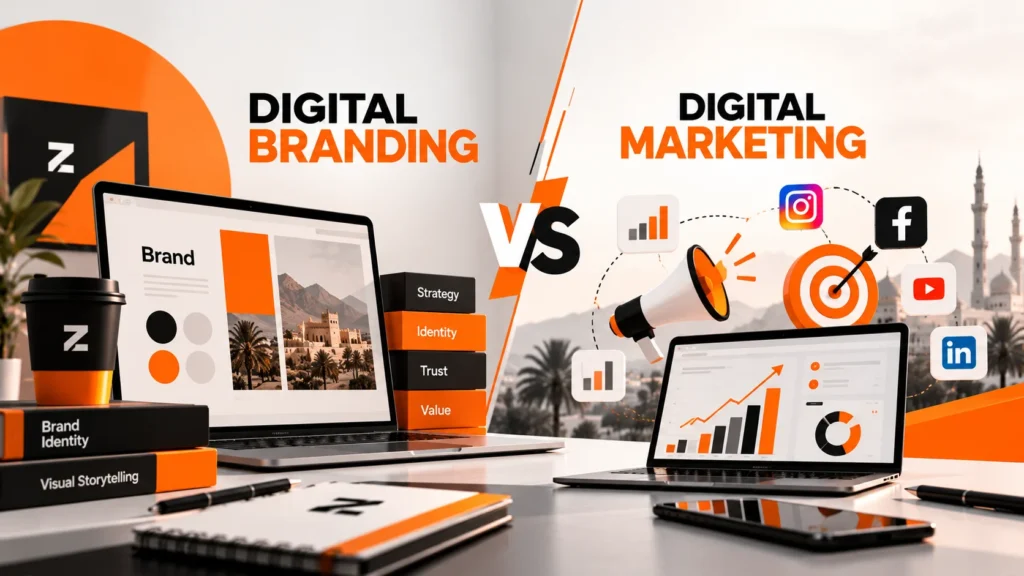
When comparing digital branding vs digital marketing, it is important to understand that they serve different purposes but work best together. Digital branding shapes how people see, remember, and trust a business, while digital marketing uses online channels to attract customers, generate leads, and increase sales. A company may run successful advertising campaigns but still struggle to build customer loyalty if its brand identity is weak. Another business may have a strong brand but fail to reach enough potential customers because its marketing activities are limited. Understanding the difference between digital branding and digital marketing helps businesses build a clear identity, reach the right audience, and create sustainable growth in 2026.
What Is Digital Branding and How Does It Work?
Digital branding is the process of creating and managing a business’s identity across online platforms. It influences how customers recognize a company, understand its values, and feel about its products or services.
Digital branding includes more than a logo or a color palette. It covers the full online experience, from the way a website looks to the tone of social media posts and the quality of customer communication.
Key Elements of Digital Branding
A business develops its digital brand through several elements:
- Visual identity: Logo, colors, fonts, photography, and graphic design.
- Brand voice: The language and tone used in website content, emails, and social media.
- Brand values: The ideas and promises that guide the business.
- Customer experience: How easy it is to browse, ask questions, buy, and receive support.
- Online reputation: Reviews, customer comments, recommendations, and public responses.
- Content identity: The topics, stories, and useful information associated with the brand.
For example, imagine a marketing company in Oman that uses consistent orange and black colors, explains its services in simple language, shares useful marketing advice, and responds professionally to customer questions. Over time, these repeated experiences can make the company easier to recognize and remember. That is the role of digital branding.
The main purpose is not to convince every visitor to buy immediately. Instead, digital branding helps people understand what a business stands for and why they might trust it when they need its services.
What Is Digital Marketing and What Does It Achieve?
Digital marketing uses online channels and measurable activities to connect a business with potential customers. Its goals may include increasing website traffic, generating leads, encouraging purchases, or bringing existing customers back.
Unlike digital branding, which focuses on identity and perception, digital marketing often focuses on specific actions and business results. However, effective marketing also contributes to brand awareness and trust.
Common Digital Marketing Activities
- Search engine optimization (SEO): Improving a website’s visibility in organic search results.
- Paid advertising: Using platforms such as Google Ads and social media advertising networks.
- Content marketing: Publishing articles, guides, videos, and other helpful content.
- Social media marketing: Reaching and engaging audiences through social platforms.
- Email marketing: Sending relevant messages, offers, and updates to subscribers.
- Performance marketing: Measuring campaigns against defined actions, such as leads or sales.
- Conversion optimization: Improving landing pages, forms, and checkout processes to help more visitors take action.
Consider a furniture store in Muscat that wants more online orders. It may improve product pages for search engines, run paid ads for popular furniture, publish buying guides, and send offers to customers who have agreed to receive emails. These activities are part of digital marketing because they aim to attract relevant visitors and encourage measurable actions.
The right approach depends on the business objective. A company that needs immediate enquiries may focus on paid search and landing pages. A business entering a new market may need more awareness-building content before expecting strong sales.
Digital Branding vs Digital Marketing: The Main Differences
The key difference in digital branding vs digital marketing is the outcome each activity is designed to create. Digital branding builds recognition, meaning, and trust. Digital marketing helps a business reach its audience and encourage actions that support commercial goals.
| Comparison point | Digital branding | Digital marketing |
|---|---|---|
| Main purpose | Build a recognizable and trusted identity | Reach customers and encourage action |
| Primary focus | Perception, reputation, and brand meaning | Traffic, leads, sales, and engagement |
| Typical activities | Visual identity, brand voice, storytelling, reputation management | SEO, paid ads, email campaigns, social media promotion |
| Time frame | Usually develops over time | Can produce short-term or long-term results |
| Common measurements | Brand recognition, branded searches, sentiment, trust indicators | Clicks, conversions, cost per lead, revenue, return on ad spend |
| Customer question | “Why should I recognize or trust this business?” | “What can this business offer me, and what should I do next?” |
| Role in growth | Helps create familiarity and preference | Creates opportunities for discovery, enquiries, and purchases |
These differences are useful when planning budgets, but they should not be treated as strict boundaries. Digital branding can improve advertising results because customers may respond more positively to a familiar company. Digital marketing can strengthen a brand by consistently delivering helpful content and a good customer experience.
A campaign can therefore support both goals. A useful educational video may attract new visitors while also making the business appear more knowledgeable. The important point is to define the main objective and measure the appropriate result.
Digital Branding vs Digital Marketing: Which One Comes First?
There is no single order that works for every business. In many cases, a company should establish a clear brand foundation before investing heavily in promotion. However, it does not need a perfect brand identity before starting digital marketing.
A practical starting point is to define three things:
- Who the business serves: Identify the main audience, its needs, and the problems it wants to solve.
- What makes the business different: Explain the value it offers and why customers might choose it.
- What action matters most: Decide whether the immediate goal is awareness, enquiries, bookings, purchases, or repeat sales.
These decisions connect digital branding with marketing activity. They help a business communicate consistently while choosing campaigns that serve a clear purpose.
For example, a new skincare brand may need a clear identity, trustworthy product information, and professional packaging before spending a large amount on advertising. It can then use educational content, search optimization, and carefully targeted campaigns to introduce its products.
An established repair company with a limited number of incoming enquiries may have a different priority. If its branding is already clear and its customer reviews are strong, it may benefit more from improving local search visibility and lead generation.
The best choice depends on the problem that is limiting growth:
- Weak brand recognition: May require stronger branding.
- Low website traffic: May require better marketing reach.
- Many visits but few enquiries: May indicate a problem with the offer, website experience, trust signals, or conversion process.
How Digital Branding and Digital Marketing Work Together
Strong results often come from combining digital branding vs digital marketing into one coordinated plan rather than treating them as separate departments.
Digital branding gives a business a consistent identity. Digital marketing puts that identity in front of relevant audiences and creates opportunities for action. Each activity can improve the performance of the other.
Imagine a company that provides professional training courses. Its brand explains that it offers practical, career-focused education. Its marketing team publishes course guides, optimizes pages for relevant searches, and runs campaigns targeting people who want to develop specific skills.
The branding communicates the company’s position. The marketing attracts people who may be interested in that position. When visitors reach the website, consistent messaging helps them understand the offer and decide whether it fits their needs.
Five Steps to Align Branding and Marketing
- Create a consistent message. Use the same core value proposition across the website, ads, social media, and email.
- Match campaigns to customer needs. Address the questions people ask before they choose a product or service.
- Make every touchpoint recognizable. Use consistent visual elements and a suitable brand voice.
- Deliver the promised experience. Ensure that customer service and product quality support the claims made in marketing.
- Measure results from both sides. Track campaign performance alongside indicators of brand recognition, trust, and customer loyalty.
A business should avoid making promises in advertisements that its website or service cannot support. That gap can weaken trust, even if the campaign initially generates clicks.
For businesses that want to study how creative ideas and commercial objectives can work together, the best digital marketing campaigns offer useful examples of how a clear message, audience insight, and campaign execution can reinforce one another.
Digital Branding vs Digital Marketing Across Different Online Channels
Different online channels support digital branding and digital marketing in different ways. A business does not need to use every platform. It should choose channels based on its audience, budget, objectives, and available resources.
Website and Search Engine Optimization
A website is often where customers form their first detailed impression of a business. Its design, navigation, writing, and service information all contribute to digital branding.
SEO supports digital marketing by helping relevant pages appear when people search for answers, products, or services. A useful article can attract organic traffic, while clear service pages can turn visitors into enquiries.
For example, an Omani company offering business software could publish a guide that explains how small businesses choose suitable software. The guide may attract visitors through search, demonstrate the company’s knowledge, and direct interested readers to a relevant service page.
SEO should not focus only on rankings. Search intent matters. Someone searching for a definition needs an informative page, while someone comparing providers may need service details, evidence of experience, and clear next steps.
Social Media
Social media supports digital branding through consistent visuals, tone, stories, and public interactions. It supports digital marketing through targeted campaigns, promotional content, audience engagement, and traffic generation.
A restaurant, for instance, may use short videos to show its food preparation and atmosphere. These videos can help people recognize the restaurant’s personality while encouraging them to view the menu or make a booking.
Posting frequently is not enough. Content should have a purpose, whether it is to answer a question, demonstrate a product, introduce a team member, share customer feedback, or encourage an action.
Businesses that need support with planning and managing social content can explore a social media marketing agency to understand how professional social media work can fit into a wider marketing plan.
Paid Advertising
Paid ads can produce visibility quickly, but digital branding influences how people interpret the message they see. A consistent logo, clear offer, and trustworthy landing page can help make an ad feel credible.
For digital marketing, paid campaigns provide measurable information such as impressions, clicks, conversions, and acquisition costs. However, high click numbers do not automatically mean a campaign is successful. A business needs to check whether those clicks lead to relevant enquiries or sales.
A company should also compare the quality of leads from different campaigns. Ten enquiries from people who need the service may be more valuable than one hundred clicks from an audience that is unlikely to buy.
Email Marketing
Email can support digital branding by maintaining a consistent tone and providing useful information after a customer subscribes. It supports digital marketing by promoting relevant offers, sharing updates, and encouraging repeat purchases.
For example, an online store may send product care advice after an order and later recommend related products when appropriate. This approach can be more helpful than sending frequent discount emails without considering customer interests.
Email communication should respect consent and applicable privacy rules. A strong brand experience also includes making preferences and unsubscribe options easy to find.
Video and Digital Content
Video can make digital branding more personal by showing people, processes, product details, or customer experiences. It can also support digital marketing when used to explain an offer, answer common questions, or direct viewers to a relevant page.
A short video explaining how a service works may help potential customers understand the process before contacting the company. A product demonstration can answer practical questions that a static image cannot.
The content should match the audience and platform. A technical explanation may work well as a detailed website video, while a brief demonstration may be better for social media.
Digital Branding vs Digital Marketing for Businesses in Oman
Businesses in Oman need to consider local audience expectations, language preferences, buying habits, and the way customers research providers. A suitable approach to digital branding vs digital marketing should reflect the business’s actual market instead of copying a strategy designed for another country.
A company serving customers in Muscat may need different content from a business selling across the entire country. Local service providers may benefit from accurate business details, location-specific pages, customer reviews, and clear service areas. Businesses selling across Oman may need broader content that addresses different customer needs and delivery arrangements.
Language also matters. Depending on the audience, businesses may need Arabic content, English content, or both. Translations should communicate the same meaning and value proposition rather than simply repeat the same wording in another language.
Here are practical examples of how digital branding and digital marketing can support different businesses in Oman:
| Business type | Digital branding priority | Digital marketing priority |
|---|---|---|
| Restaurant | Food quality, atmosphere, identity, and customer experience | Local search, social content, promotions, and bookings |
| B2B service provider | Expertise, reliability, and clear service positioning | SEO, case studies, LinkedIn content, and lead generation |
| Online store | Consistent product presentation and customer confidence | Product SEO, paid campaigns, email, and conversion optimization |
| Tourism business | Authentic experiences, service standards, and memorable visuals | Search visibility, video content, relevant campaigns, and enquiries |
| Professional consultancy | Credibility, specialist knowledge, and a clear point of view | Educational content, search marketing, and qualified lead generation |
For companies comparing providers, a marketing agency can help coordinate brand positioning, content, and campaign activity when those services match the company’s needs.
Businesses looking for regional experience can also review Digital marketing agency in Oman services and evaluate whether the provider understands their audience, industry, and business goals. The right partner should explain its proposed approach clearly and identify how performance will be measured.
How to Measure Digital Branding vs Digital Marketing Results
One common mistake is using the same metrics for every activity. Digital branding and digital marketing have related but different goals, so they need a balanced measurement plan.
Brand-related results can take longer to develop. Campaign results may appear more quickly, but they still require context. A single metric rarely tells the whole story.
Digital Branding Metrics
Businesses can use several indicators to understand whether their brand is becoming more recognizable and trusted:
- Branded search volume: How often people search for the company by name.
- Direct website traffic: Visits that arrive without a clearly identified external referral.
- Brand mentions: How often people refer to the business online.
- Audience sentiment: Whether comments and reviews show positive, neutral, or negative reactions.
- Repeat customer activity: Whether customers return over time.
- Brand consistency: Whether the website, social media, and other customer touchpoints communicate a clear identity.
These indicators need careful interpretation. Direct traffic, for example, can be affected by tracking limitations and customer behavior. A rise in branded searches may indicate growing awareness, but it should be considered alongside other evidence.
Digital Marketing Metrics
The right digital marketing metrics depend on the campaign objective:
- Impressions and reach: How many times content was displayed and how many people it reached, depending on the platform’s definitions.
- Click-through rate (CTR): The percentage of impressions that generated clicks.
- Conversion rate: The percentage of relevant visits or interactions that completed a desired action.
- Cost per lead (CPL): Advertising or campaign cost divided by the number of leads generated.
- Customer acquisition cost (CAC): The cost of acquiring a customer across the relevant activities included in the calculation.
- Return on ad spend (ROAS): Attributed revenue divided by advertising spend.
- Customer lifetime value (CLV): An estimate of the value a customer generates during the relationship with the business.
Metrics should be selected before a campaign begins. If the goal is to generate qualified leads, measuring success mainly by likes or impressions can create a misleading picture.
How to Connect Both Types of Measurement
A useful reporting process connects brand indicators with business outcomes. For example, a business may notice that branded searches are increasing while its paid search campaigns are generating more qualified enquiries. This combination can help explain how awareness and demand are developing, although it does not prove that branding alone caused the change.
Use a simple reporting routine:
- Record the starting position before major activity begins.
- Set separate brand and campaign objectives.
- Review results over a suitable time period.
- Compare lead quality and sales outcomes, not just traffic.
- Identify which activities deserve more investment, testing, or improvement.
This approach makes digital branding vs digital marketing easier to evaluate without assuming that every result comes from one channel.
Common Mistakes in Digital Branding vs Digital Marketing
Businesses can spend money on online activity without making meaningful progress. The problem is often not the channel itself but the lack of alignment between the brand, the offer, and the customer’s needs.
- Mistake 1: Treating a logo as the whole brand. A logo helps people recognize a business, but digital branding also depends on its message, reputation, service quality, and customer experience.
- Mistake 2: Expecting paid ads to solve every problem. Advertising can bring visitors to a website, but digital marketing will struggle if the landing page is confusing, the offer is unclear, or the business fails to respond to enquiries.
- Mistake 3: Using inconsistent messages. If a company presents itself as premium on its website but relies on unclear promotions elsewhere, customers may find it difficult to understand its position. Consistency helps connect digital branding across different channels.
- Mistake 4: Measuring activity instead of outcomes. Publishing many posts or generating clicks does not automatically create revenue. Effective digital marketing needs objectives and measurements that reflect business priorities.
- Mistake 5: Copying competitors without understanding customers. A competitor’s campaign may be designed for a different audience, price point, or sales process. Businesses should use research to shape their own digital branding and marketing decisions.
- Mistake 6: Ignoring the experience after conversion. The relationship does not stop when someone buys. Clear communication, reliable delivery, and useful support can influence repeat business and the way customers talk about a brand.
A Practical 90-Day Plan for Digital Branding and Digital Marketing
A 90-day plan can help a business improve digital branding while testing marketing activities without trying to change everything at once.
90-Day Digital Branding and Marketing Roadmap
| Period | Main focus | Suggested actions | What to review |
|---|---|---|---|
| Days 1–30 | Research and brand foundation | Review the website, audience, competitors, customer feedback, brand message, and existing campaign data | Baseline visibility, enquiries, conversion rates, and brand consistency |
| Days 31–60 | Content and campaign setup | Improve priority pages, create useful content, prepare campaign landing pages, and test suitable channels | Traffic quality, engagement, leads, and early conversion signals |
| Days 61–90 | Testing and improvement | Compare campaign variations, improve weak pages, review lead quality, and refine messaging | Cost per lead, conversions, sales contribution, and brand indicators |
Days 1–30: Define the Position and Fix Basic Problems
Start by checking whether the website explains what the business offers, who it serves, and what makes it relevant. Review the most important pages for unclear messages, missing contact information, slow loading, or difficult navigation.
At this stage, digital branding work may include:
- Refining the brand message.
- Checking visual consistency.
- Identifying the questions customers need answered.
Marketing work may include reviewing search visibility, traffic sources, and existing campaign performance.
Days 31–60: Publish and Promote Useful Content
Choose content based on real customer questions rather than publishing articles simply to fill a calendar. Create pages that match search intent, explain services clearly, and offer a useful next step.
Use digital marketing campaigns to reach relevant audiences, but make sure each campaign leads to a page that matches its promise. A campaign promoting a particular service should not send every visitor to a general homepage if a more relevant page is available.
Days 61–90: Test, Learn, and Improve
Review what happened during the first two months. Ask these questions:
- Which pages attracted relevant visitors?
- Which campaigns generated qualified enquiries?
- Where did people leave without taking action?
Use those findings to improve both digital branding and marketing execution. A page may need clearer language or stronger evidence of credibility. An advertising campaign may need a different audience, offer, or landing page.
Ninety days is enough to identify useful patterns and make informed adjustments, but it is not a guarantee of a specific ranking, revenue increase, or return. Results depend on the industry, competition, budget, implementation quality, and customer demand.
How to Choose the Right Digital Marketing Partner
A business may need outside support when it lacks the time, skills, or resources to manage digital branding and marketing internally. Choosing a partner should begin with the business problem, not with a list of services.
Questions to Ask Potential Providers
Before making a decision, ask potential providers:
- How will you understand our business and target audience?
- Which activities do you recommend first, and why?
- How will you keep our brand message consistent across channels?
- Which metrics will you report, and how often?
- How will you measure lead quality or sales impact?
- What access, content, and information will you need from our team?
- How will you handle testing, reporting, and changes in priorities?
Choosing the Right Instagram Management Support
Businesses with an active Instagram presence may also need a specialist approach to content planning, community management, and performance tracking.
Reviewing the best Instagram management service can help clarify the types of support available and whether they fit the business’s wider objectives.
What to Expect From a Digital Marketing Partner
A suitable provider should explain what it can deliver, what it needs from the client, and which results can reasonably be measured. Be careful with promises of guaranteed rankings or fixed sales results, since online performance depends on factors beyond an agency’s direct control.
The best partnership connects digital branding with measurable marketing activity while keeping business priorities at the center of the plan.
Frequently Asked Questions About Digital Branding vs Digital Marketing
1. What is the main difference between digital branding and digital marketing?
Digital branding builds a business’s online identity, reputation, and customer perception. Digital marketing uses online channels to attract audiences and encourage actions such as enquiries, purchases, or bookings. They work best when planned together.
2. Is digital branding part of digital marketing?
Digital branding and digital marketing are closely related, but they are not the same. Branding can support marketing by building recognition and trust, while marketing can increase brand visibility through content, search, advertising, and social media.
3. Which is more important for a small business?
The priority depends on the business’s current challenge. A new business may need a clear identity and basic trust signals before investing heavily in promotion. A business with strong branding but few enquiries may need to improve its digital marketing reach, targeting, or conversion process.
4. Can digital marketing work without digital branding?
Yes, some campaigns can generate clicks, leads, or sales without a fully developed brand strategy. However, weak or inconsistent digital branding may make it harder for customers to recognize the business, trust its message, or remember it later.
5. How long does digital branding take to show results?
There is no fixed timeline. Some improvements, such as clearer messaging and a more consistent website, can change the customer experience quickly. Broader changes in recognition, trust, and reputation usually require repeated positive experiences over time.
6. How do you measure digital branding success?
Businesses can review branded searches, online mentions, customer feedback, repeat customer activity, and consistency across online touchpoints. These indicators should be considered together because no single metric fully represents digital branding performance.
7. Which digital marketing channels should a business use first?
Start with the audience and business goal. SEO may be useful when customers actively search for a solution. Paid ads may help test demand or reach a specific audience. Social media can support discovery and engagement, while email can help maintain relationships with people who have subscribed.
8. Does digital branding matter for B2B companies?
Yes. Digital branding helps B2B companies communicate expertise, reliability, and a clear position in the market. Useful articles, case studies, consistent service information, and professional communication can support the longer decision-making process common in B2B purchases.
9. What is the difference between brand awareness and lead generation?
Brand awareness measures how effectively people recognize or become familiar with a business. Lead generation focuses on attracting potential customers who take a step such as submitting a form, calling, or requesting a quotation. A coordinated digital branding and digital marketing plan can support both goals.
10. Should a business hire a digital branding agency or a digital marketing agency?
Choose based on the main need. A business with an unclear identity may need branding expertise, while one that needs more relevant traffic or enquiries may need marketing support. Some providers offer both, so review their actual capabilities, process, and reporting before deciding.
For businesses planning growth in Oman, Ground Z can be a starting point for exploring digital marketing services that fit their audience and objectives. The most useful plan is one that connects a recognizable brand with relevant campaigns, a clear customer experience, and measurable business goals.